
Sntieecr STEM Electric Circuit Motor Kit, Science Experiment Educational Kit
4.2Editor score
Complete circuit kit
Includes motors and bulbs
Affordable price point
This guide compares the top electricity learning kits for students and beginners, evaluating project variety, safety, and educational value to help you choose
Electricity learning kits provide hands-on experiences that transform abstract scientific concepts into tangible understanding for students of all ages. These educational tools allow learners to build circuits, explore magnetism, and grasp the fundamentals of physics through interactive experimentation and guided discovery.
Our team analyzed ten highly-rated kits available this month, evaluating each based on component quality, instruction clarity, project diversity, and safety features. We considered feedback from educators, parents, and students to ensure our selections offer the most effective and engaging learning environments for aspiring engineers and science enthusiasts.
Each review below details a specific kit's strengths, limitations, and ideal user profile to help you make an informed decision. Please note that availability and promotional offers may vary over time, so checking the latest product pages ensures you receive the most current information before purchasing.
4.2Editor score

4.7Editor score

4.5Editor score
The following table provides a side-by-side comparison of all ten selected electricity learning kits, highlighting their core specifications, target age groups, and unique selling points to facilitate quick decision-making.



This National Geographic kit stands out as the premier choice for young learners due to its massive library of over 120 electrical projects. With a rating of 4.7 stars, it offers an unmatched depth of content that keeps children engaged for hours while teaching fundamental circuit concepts.
We may earn a commission when you buy through this link, at no additional cost to you.
The standout feature is the ease of use; components connect securely without tools, and QR codes link to video instructions for guided learning. This approach significantly reduces frustration and allows kids to focus on the science rather than assembly mechanics, fostering creativity and confidence.
While the kit lacks included batteries and commands a higher price, the sheer volume of activities and educational value justify the investment. The durable components ensure long-term use, making it a reliable resource for repeated experimentation and growing interest in electrical engineering.
Ideal for curious kids aged 8 and up, this kit provides a safe, structured, and fun environment to explore electricity. It is the top recommendation for parents seeking a comprehensive STEM gift that balances entertainment with serious educational outcomes.
With over 120 activities ranging from light shows to sound systems, this kit ensures learners never run out of new challenges to tackle.
The design prioritizes safety with snap-together components and no tools required, making it accessible for younger children and beginners.
We may earn a commission when you buy through this link, at no additional cost to you.
The Sntieecr kit offers an incredibly accessible entry point into electrical engineering for families on a budget. Rated at 4.2 stars, it provides all the essential components to build simple circuits, including motors and bulbs, making it a practical choice for quick STEM projects.
We may earn a commission when you buy through this link, at no additional cost to you.
Its primary strength lies in its affordability and versatility, allowing users to experiment with basic electrical principles without a significant financial commitment. The kit encourages children to turn new ideas into reality, serving as an excellent Montessori-style learning toy for curious minds.
Users must be mindful of voltage limits to prevent overheating, as the components can generate heat during extended use. While not as robust as premium kits, it effectively teaches fundamental rules and provides adequate interaction time for kids under adult supervision.
Best suited for children aged 8 and older, this kit is perfect for school science fairs or casual home experiments. It remains a top pick for budget-conscious parents who want to introduce their kids to science without overspending.
This kit delivers core learning experiences at a low cost, making electrical science accessible to a wider audience of students and families.
Children can easily build and modify circuits to see immediate results, fostering a deeper understanding of how electricity powers devices.
We may earn a commission when you buy through this link, at no additional cost to you.
The EUDAX School Physics Labs kit is designed for high school students seeking a deeper understanding of electricity and magnetism principles. With a 4.5-star rating, it combines theoretical knowledge with practical application through 56 items for electricity and 21 for magnetism.
We may earn a commission when you buy through this link, at no additional cost to you.
This kit excels in providing a complete educational experience, featuring full-color manuals that explain the 'why' behind each experiment. Students can explore complex topics like Ohm's law and electromagnetism in a structured environment that supports independent learning and critical thinking.
While the kit requires three AA batteries and may be too advanced for younger children, its comprehensive nature ensures a rich learning environment for older students. The inclusion of repair tools and organized storage adds to its practicality for sustained use.
Recommended for grades 9 through 11, this kit is ideal for those preparing for advanced science courses or simply passionate about electronics. It bridges the gap between classroom theory and real-world application effectively.
Designed for older students, this kit covers complex topics like electromagnetism and Ohm's law, preparing learners for higher-level physics studies.
The inclusion of repair tools and detailed manuals ensures students can troubleshoot issues and fully grasp the scientific principles involved.
We may earn a commission when you buy through this link, at no additional cost to you.
The STEM Electric Circuit Kit offers a focused yet engaging set of eight experiments designed to teach kids and teens about electrical circuits. Rated 4.5 stars, it includes a detailed circuit book and unique projects like fruit batteries and saltwater power generation.
We may earn a commission when you buy through this link, at no additional cost to you.
Its strength lies in the variety of ways to light a bulb, encouraging problem-solving and creativity. The structured learning path allows young engineers to understand conductivity and energy conversion through hands-on fun and practical application of science concepts.
While it only includes eight projects and requires separate batteries, the quality of instruction and project design make it a solid choice for introductory learning. It is perfect for science fairs or family activities that aim to spark interest in technology.
Suitable for ages 8 to 14, this kit is a great tool for fostering critical thinking and exploration. It serves as an excellent intermediate option for those who want more than basics but less complexity than full physics labs.
Projects like fruit batteries and saltwater power generation offer unique ways to explore energy sources and conductivity beyond standard batteries.
The detailed circuit book provides clear instructions and theory explanations, ensuring learners understand the principles behind each experiment.
We may earn a commission when you buy through this link, at no additional cost to you.
The Mysterystone kit is a comprehensive bundle that combines electricity and magnetism learning into over 50 do-it-yourself experiments. Rated 4.4 stars, it includes unique items like magnetic switches and light control LEDs, offering a robust introduction to physics concepts.
We may earn a commission when you buy through this link, at no additional cost to you.
This kit excels in its well-written manual, which explains the 'why' behind experiments and encourages students to design their own variations. The solid storage case ensures all 55 items are organized and portable, making it easy to take projects to friends or school.
While the kit offers extensive learning opportunities, it may require adult guidance for younger users due to the technical nature of some components. However, the potential for creative design and exploration makes it a rewarding tool for motivated students.
Ideal for physics enthusiasts, this kit helps students visualize abstract concepts like electromagnetism concretely. It is a strong candidate for those looking to deepen their understanding of STEM subjects through hands-on experimentation.
Items like magnetic switches and light control LEDs provide exposure to specialized components found in more advanced electronics.
The manual guides students to understand principles so they can invent new experiments, fostering creativity and engineering skills.
We may earn a commission when you buy through this link, at no additional cost to you.
The Teenii kit is designed to foster curiosity and observation through a 50-piece electricity and magnetism set. With a 4.4-star rating, it includes essential tools like an amper/voltmeter and a 40-page full-color manual to support guided learning.
We may earn a commission when you buy through this link, at no additional cost to you.
Its primary appeal lies in its suitability for parent-child discovery activities, encouraging families to explore science together. The inclusion of measurement tools allows for more scientific rigor, teaching kids how to quantify electrical values rather than just observe light.
While it has fewer projects than some competitors, the durability of materials and focus on safety make it a reliable choice for home or classroom use. It is an excellent gift for birthdays or holidays to inspire STEM interests.
Recommended for ages 8 and up, this kit bridges the gap between play and serious science. It is a strong option for families looking to engage in educational activities that promote critical thinking and scientific skills.
The inclusion of an amper/voltmeter allows learners to measure actual electrical values, adding a quantitative layer to the experiments.
The kit is structured to encourage collaborative work, making it ideal for parents and children to explore science together.
We may earn a commission when you buy through this link, at no additional cost to you.
The Physics Labs Basic Electricity kit offers a structured approach to learning physics, featuring 55 electricity and 22 magnetism items. Rated 4.5 stars, it includes unique components like a sensitive ammeter and magnetically controlled switch to explore advanced concepts.
We may earn a commission when you buy through this link, at no additional cost to you.
The experimental manual is a key strength, detailing operation steps and explaining the equipment required for each experiment. This guidance ensures students understand the operation and equipment, making it suitable for independent learning or school projects.
Although batteries must be purchased separately and setup can be involved, the kit provides a complete educational experience. The sturdy storage box keeps components organized and portable, which is ideal for classroom environments or home study.
Best for junior and senior high school students, this kit supports exploration of electric circuits and magnetic fields. It is a solid choice for those seeking a comprehensive curriculum to understand physics principles in depth.
The manual explains not just what to do but why, ensuring students build a solid theoretical foundation alongside practical skills.
Designed for grades 7-11, the content aligns well with standard physics curricula, making it useful for supplementing schoolwork.
We may earn a commission when you buy through this link, at no additional cost to you.
The EUDAX Basic kit is a safe and simple option for students starting their journey in electricity. Rated 4.6 stars, it focuses on building series and parallel circuits, helping learners consolidate textbook knowledge with hands-on practice.
We may earn a commission when you buy through this link, at no additional cost to you.
Its strength lies in its simplicity and clear English instructions, which make assembly straightforward for junior high students. The kit helps improve hands-on ability and creativity by setting up simple circuits without overwhelming technical details or advanced requirements.
While it lacks magnetism and advanced features, it serves as an ideal introduction for grades 7 to 9. The plastic storage box keeps parts organized, and the focus on safety ensures a secure learning environment for younger learners.
Perfect for summer camps or home school units, this kit provides the essential building blocks of electrical science. It is a recommended choice for those seeking a straightforward, low-pressure introduction to physics concepts.
The kit is designed to be safe for younger learners, ensuring they can explore electricity without risk of complex electrical hazards.
English instructions make it accessible for a wide range of users, ensuring students can follow along without language barriers.
We may earn a commission when you buy through this link, at no additional cost to you.
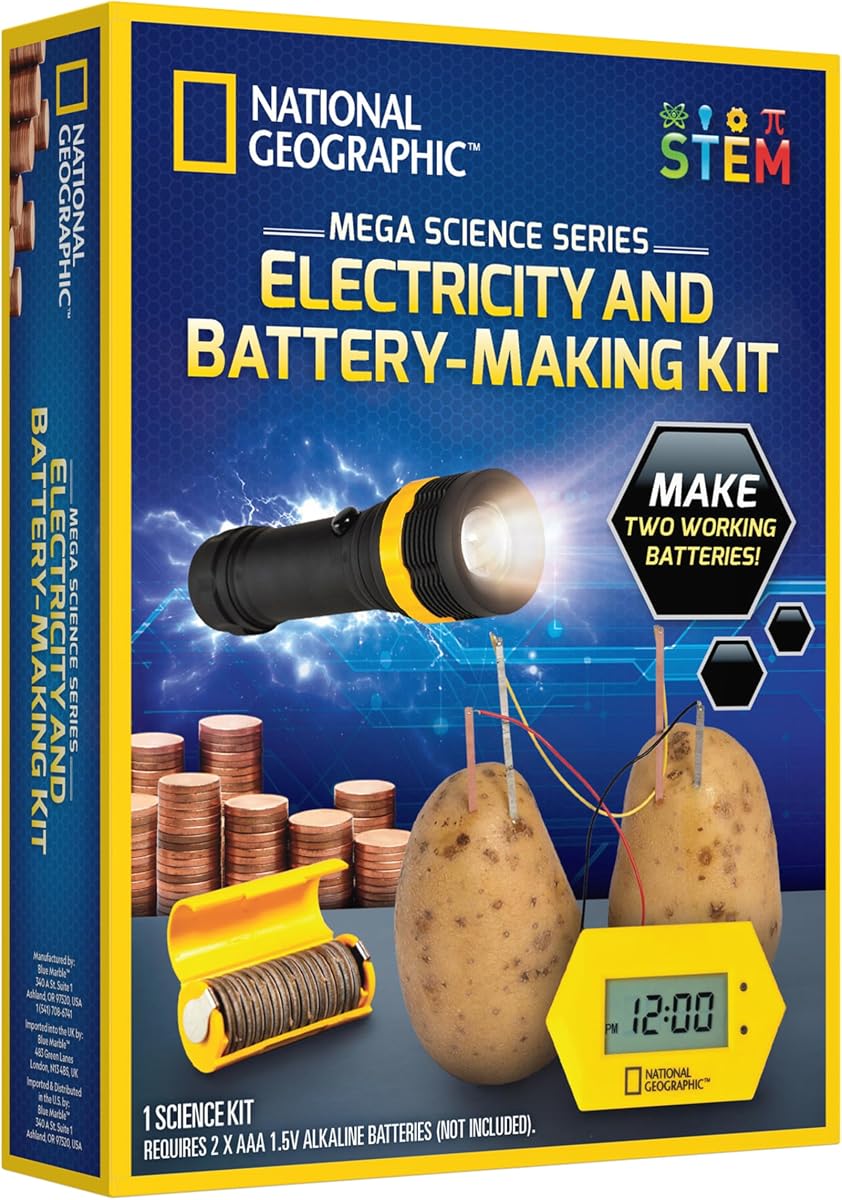
The National Geographic Battery Making Kit focuses specifically on how batteries work, offering two memorable projects like a potato clock and penny flashlight. Rated 4.5 stars, it teaches kids about electrical engineering through tangible, interactive experiments that stick.
We may earn a commission when you buy through this link, at no additional cost to you.
Its primary advantage is the unique nature of the experiments; building a battery from household items like potatoes creates a powerful 'wow' moment. The detailed learning guide explains the science behind these projects, deepening understanding of energy conversion.
While the kit only includes two projects, the impact of these specific experiments is high. It is perfect for those interested in renewable energy or specific battery chemistry concepts rather than general circuit building.
Ideal for curious kids who want to understand power sources, this kit is a great science gift. It stands out for its ability to turn everyday materials into functional electrical components in an educational way.
By building batteries from potatoes and coins, children learn the chemical basis of electricity in a way that abstract circuit kits cannot.
The projects result in functional devices like a clock and flashlight, giving kids a sense of accomplishment and practical understanding.
We may earn a commission when you buy through this link, at no additional cost to you.
The EUDAX Upgrade kit offers an expanded set of projects compared to the basic version, including a wind power car and traffic light. Rated 4.4 stars, it provides a broader range of electrical and magnetic models for students in grades 7 to 11.
We may earn a commission when you buy through this link, at no additional cost to you.
Its strength is the inclusion of more complex projects that require integrating multiple components to achieve a goal. The transparent storage box helps users see all parts at a glance, which streamlines the building process for longer experiments.
While it shares similar requirements with other kits, such as needing AA batteries, the added project variety makes it a compelling upgrade for those who want more depth. It supports hands-on learning that bridges theory and practical application.
Recommended for students ready to tackle more involved designs, this kit offers a step up from basic circuit building. It is an excellent choice for teachers or parents looking to challenge students with diverse and engaging projects.
From wind power cars to traffic lights, the upgrade kit introduces more complex projects that require integrated system thinking.
The transparent box allows easy visual access to components, saving time on sorting and ensuring a organized workspace.
We may earn a commission when you buy through this link, at no additional cost to you.
Choosing the right kit depends on age, experience level, and educational goals. Use these factors to narrow down the best option for your needs.
Ensure the kit matches the child's age and motor skills. Kits for younger kids often use snap-together parts, while older students may handle tools and complex wiring.
Look for age recommendations on the packaging to ensure safety and usability.
Consider how many different experiments the kit supports. More variety means longer engagement and broader learning opportunities.
Select a kit with a sufficient number of projects to sustain interest over time.
Durable materials ensure the kit can withstand repeated use. Check for robust wires, switches, and connectors that do not break easily.
Invest in kits with high-quality components to avoid frustration during assembly.
Detailed manuals and video tutorials help learners understand the theory behind experiments. Look for kits with clear step-by-step guides.
Strong instructional support reduces frustration and enhances the educational value.
Ensure the kit uses low voltage and has safe components. Avoid kits that generate excessive heat or use high-voltage batteries without supervision.
Safety should be a top priority when selecting electrical kits for children.
Organized storage boxes keep parts from getting lost. Kits with fixed positions for items make packing and unpacking easier.
Good storage solutions help maintain the kit's condition and organization over years.
The kit should align with scientific principles taught in school. Look for resources that explain concepts like circuits, magnetism, and energy.
Prioritize kits that balance fun with rigorous educational content.
Check if batteries or extra tools are included. Some kits require specific items that add to the cost.
Factor in these additional needs when comparing the overall value of different kits.
Start by reading the manual thoroughly to understand the components and safety warnings before building any projects. This helps prevent accidental short circuits or incorrect connections that could damage the kit.
Store all components in the provided case after each use to keep wires organized and parts from getting lost. Proper storage ensures you can find what you need quickly for future experiments.
Follow voltage limits strictly to avoid overheating the components. If using batteries, ensure they are inserted correctly and removed when not in use to prolong the life of the kit.
Most electricity learning kits do require batteries to power the experiments. Typically, AA batteries are used, but they are often sold separately. Always check the product details to confirm how many and what type are needed.
Yes, most kits are designed with safety in mind, using low voltage and child-friendly materials. However, adult supervision is recommended for younger children to prevent short circuits or misuse of small parts.
The kits vary by age range, typically from 8 years old up to high school students. Basic kits are better for younger learners, while advanced physics kits suit older students ready for complex concepts.
Absolutely, these kits are excellent for school science fairs and projects. They provide hands-on learning and clear documentation that can support educational requirements and presentations.
Most kits include detailed manuals with step-by-step instructions. Some even offer video tutorials via QR codes to help guide you through each experiment and explain the theory.
If a component breaks, contact the manufacturer for replacement parts or customer service support. Many brands offer after-sales service to ensure you can continue your experiments without interruption.
We hope this guide has helped you find the perfect electricity learning kit for your educational needs. Our top picks offer a range of options from budget-friendly basics to comprehensive physics labs.
Prioritize kits that match the user's age and interest level to ensure a rewarding learning experience. Safety and instruction clarity are also key factors to consider before making a purchase.
Remember to check the current availability and product pages for the most accurate details. Happy experimenting and enjoy discovering the wonders of electricity!