
Cell Phone Signal Booster for Home RV
5.0Editor score
70dB signal gain
Wide carrier compatibility
Durable aluminum housing
This guide compares the top 4G and 5G booster for RV options to help you choose the best signal amplifier for your mobile lifestyle needs.
Staying connected while traveling in your recreational vehicle is more important than ever. Modern digital and 5G booster for RV solutions provide the reliable connectivity needed for work, entertainment, and safety on the road.
We evaluated ten leading signal boosters based on performance, carrier compatibility, installation ease, and user reviews. Our analysis focuses on models that deliver consistent gains across various terrains and signal conditions.
Each pick highlights key features, pros, cons, and ideal use cases to help you decide. Prices and availability fluctuate frequently, so verify current details before making your final purchase decision today.
5.0Editor score
4.4Editor score

4.0Editor score
The following table provides a side-by-side comparison of all ten reviewed models. It highlights key specifications, ratings, and unique features to help you quickly identify the right booster for your specific vehicle and needs.


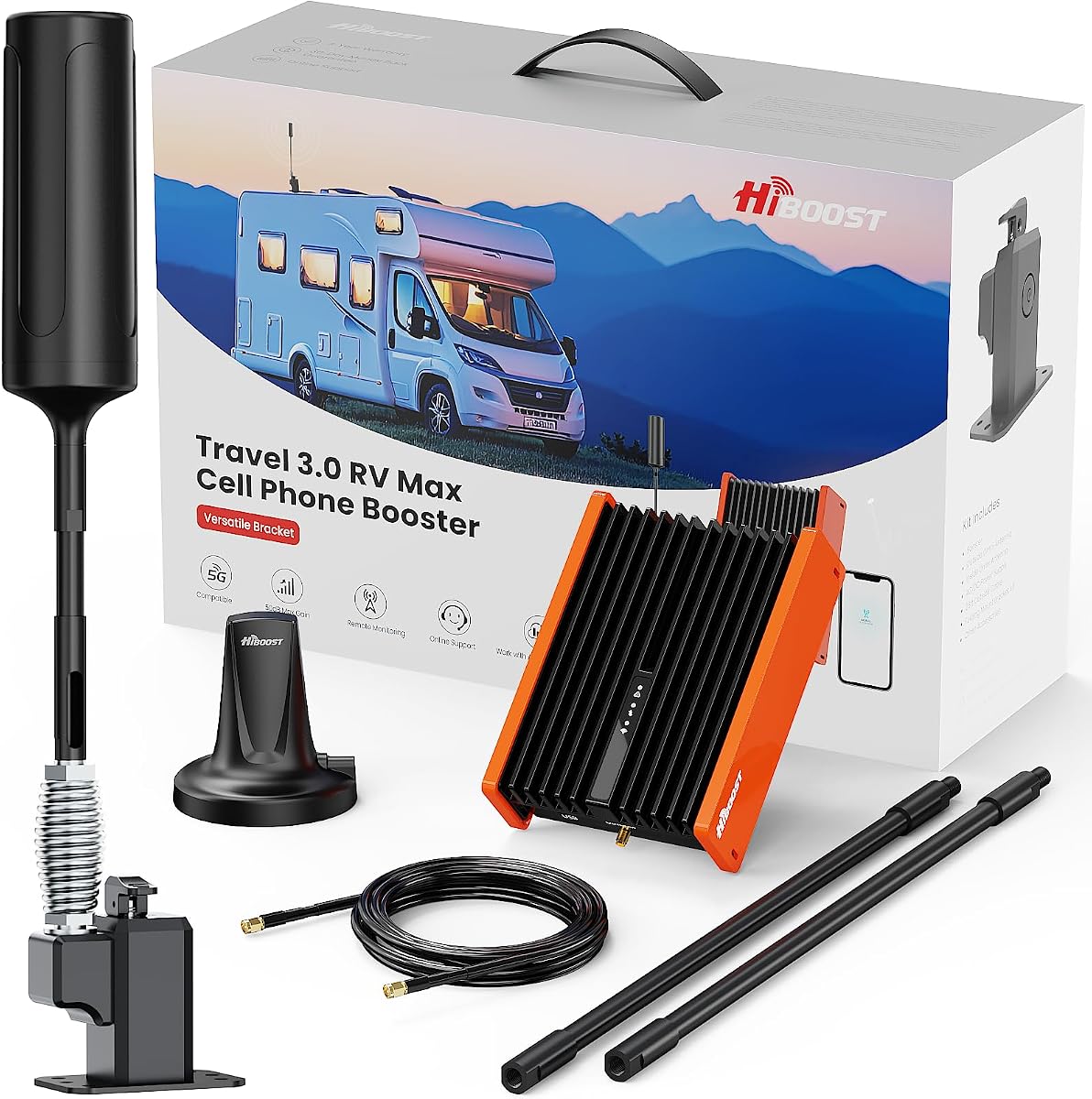
The HiBoost Travel 3.0 RV Max stands out as a top choice for RV owners who need flexibility and reliable performance. With a 4.4 rating, it offers robust 4G and 5G support across all major carriers.
We may earn a commission when you buy through this link, at no additional cost to you.
Its 180-degree foldable outdoor antenna is a game-changer for those with height restrictions or covered parking. The smart app allows you to monitor signal strength and troubleshoot issues remotely.
While the price is higher than budget options, the added features like dual power modes and extensive warranty justify the investment for serious travelers who demand consistent connectivity.
This booster is ideal for full-time RVers or those who camp in varied environments. If you need a reliable system that adapts to your lifestyle, this is a strong candidate.
The foldable antenna ensures you can mount it on roof racks or poles without hitting garage ceilings or tree branches.
Access setup videos and performance data via the mobile app to keep your connection optimized without technical expertise.
We may earn a commission when you buy through this link, at no additional cost to you.
Despite its low price, this booster delivers exceptional value with a perfect 5.0 rating. It handles 5G, 4G, and older 3G networks, making it a versatile option for various carriers and devices.
We may earn a commission when you buy through this link, at no additional cost to you.
The aluminum alloy housing provides durability against weather and road conditions, while the 360-degree cannon barrel antenna ensures even signal distribution throughout your RV interior.
While it lacks advanced monitoring features found in pricier models, it excels at its core function: amplifying weak signals for calls and basic data usage without breaking the bank.
This unit is perfect for budget-conscious travelers or those who need a backup booster. It offers the essential performance needed to stay connected without unnecessary complexity or cost.
Get reliable signal enhancement for a fraction of the cost of premium brands without sacrificing basic performance.
Works with most major carriers and phone brands, ensuring you can use your existing device without restrictions.
We may earn a commission when you buy through this link, at no additional cost to you.
weBoost Destination RV is tailored for campers who park for extended periods. It supports 5G and 4G LTE with a directional antenna that maximizes range in fixed locations.
We may earn a commission when you buy through this link, at no additional cost to you.
Built in the USA, it offers a robust build quality and excellent customer support. The setup is straightforward, taking about ten minutes to install and start using.
While it may not suit high-speed travel due to its directional nature, it shines when you are set up at a campground or remote destination for days at a time.
For those prioritizing stability and quality over mobility, this model offers peace of mind. It ensures you have a strong connection for streaming or work while parked.
The directional antenna focuses on the nearest tower, providing stronger signal when your vehicle is stationary.
Made in the USA, this product adheres to high manufacturing standards and includes expert local support.
We may earn a commission when you buy through this link, at no additional cost to you.
PRACOA offers comprehensive support across all major bands including Band 13, 12, and 17. It boosts signals up to 100x and supports multiple users simultaneously.
We may earn a commission when you buy through this link, at no additional cost to you.
The Automatic Gain Control ensures stable performance even as signal conditions change. It eliminates oscillation and noise, providing clearer calls and faster data without manual tweaking.
While it lacks smart features like app monitoring, it delivers consistent performance for general travel. The plug-and-play setup makes it accessible for users without technical skills.
This is a solid choice for RV owners who need broad carrier compatibility. It balances price and performance effectively for everyday use on the road.
Supports a wide range of bands to ensure compatibility with different towers and carrier technologies across North America.
Adjusts power automatically to prevent interference while maintaining the best possible signal strength.
We may earn a commission when you buy through this link, at no additional cost to you.
Designed for large spaces like metal buildings or large RVs, this kit covers up to 4,000 square feet. It operates on standard 5G and 4G LTE bands for reliable connectivity.
We may earn a commission when you buy through this link, at no additional cost to you.
The 360-degree omnidirectional outdoor antenna captures signals from all directions without needing precise aiming. This makes installation simpler for those who cannot point a directional antenna at a specific tower.
However, some users report setup challenges. While the FCC approval ensures safety, proper placement of the outdoor antenna is critical for achieving the claimed coverage and performance.
Consider this if you have a larger vehicle or need to cover multiple zones. The warranty support helps mitigate risks if the initial setup does not meet expectations.
Ideal for large RVs or structures where standard boosters fail to reach every corner.
Captures signals from any direction, reducing the need to aim the outdoor antenna precisely.
We may earn a commission when you buy through this link, at no additional cost to you.
weBoost Drive Reach Overland is engineered for off-road vehicles that face challenging environments. It supports 5G and 4G LTE with a tough outdoor antenna designed to withstand harsh conditions.
We may earn a commission when you buy through this link, at no additional cost to you.
The 50dB gain ensures you stay connected even when far from towers. Its rugged design is perfect for overlanding rigs that traverse remote terrain without sacrificing communication.
While it is pricey and requires manual FCC registration, the durability and performance justify the cost for serious adventurers. Expert US-based support ensures you get help when needed.
This model is ideal for those who venture off-grid. If reliability and durability are your top priorities, it offers a robust solution for off-road connectivity.
Designed to survive vibration, moisture, and physical impacts common in off-road travel.
Access US-based experts through app, chat, or phone for installation and troubleshooting.
We may earn a commission when you buy through this link, at no additional cost to you.
This booster excels for AT&T and T-Mobile users with 70dB gain and LCD display for real-time signal strength. It is built for trucks and overland vehicles with a waterproof, shockproof design.
We may earn a commission when you buy through this link, at no additional cost to you.
The LCD screen helps you find the best mounting spot quickly. Lifetime technical support adds value, ensuring you can get help whenever you face connectivity issues on the road.
However, it does not support Verizon's Band 13, which limits its versatility for Verizon users. Performance varies depending on signal availability, so check local network coverage first.
If you primarily use AT&T or T-Mobile, this is a solid choice. The durable design and support make it suitable for harsh conditions and long-term use.
LCD screen displays signal strength instantly, simplifying the installation process.
Waterproof and wear-resistant design ensures reliability in rain, dust, and extreme weather.
We may earn a commission when you buy through this link, at no additional cost to you.
HiBoost offers an HD display and app support for monitoring signal strength in real-time. It uses a directional antenna to reach distant towers, ideal for remote RV parks.
We may earn a commission when you buy through this link, at no additional cost to you.
The setup involves partnering with the app to locate the best signal point. This precision ensures optimal performance, eliminating weak spots across the RV interior.
However, it requires at least one bar of initial signal to boost effectively. If you are in a dead zone, this booster cannot create signal from nothing.
This is great for users who want visibility into their network performance. If you need precise control and monitoring, this model provides the necessary tools.
Color LCD shows real-time signal strength for precise antenna placement.
Targeted antenna design captures signals from distant towers more effectively than omni models.
We may earn a commission when you buy through this link, at no additional cost to you.
This 2-in-1 design integrates the indoor antenna into a slim unit, reducing cable clutter and installation steps by half. It covers 5G Sub-6 and 4G LTE for all major carriers.
We may earn a commission when you buy through this link, at no additional cost to you.
The fiberglass omni-directional antenna handles high winds and brush scrapes, perfect for off-road adventures. LED indicators provide visual feedback on signal quality without testing tools.
While installation is simpler, you must register the device with your provider per FCC rules. The 50dB gain is adequate for moderate signal areas but may not reach distant towers.
Ideal for those wanting a neat setup without sacrificing power. It is a practical choice for RVs where minimizing cables and maximizing simplicity are priorities.
Built-in indoor antenna removes the need for separate ceiling or wall units.
Multi-color LED lights indicate signal status instantly for easy troubleshooting.
We may earn a commission when you buy through this link, at no additional cost to you.
With a perfect 5.0 rating, this model suits both home offices and RVs. It supports 5G and 4G LTE with a 70dB gain for improved voice and data speeds.
We may earn a commission when you buy through this link, at no additional cost to you.
Installation is DIY-friendly with included brackets and video guides. It boosts speeds across common bands, eliminating dropped calls and improving battery life for devices.
While it lacks advanced monitoring, it provides solid performance for standard use. The price and ease of use make it a top choice for those wanting reliable connectivity without fuss.
Perfect for travelers who need a balance of performance and simplicity. It ensures you stay connected whether parked at home or on the road.
Versatile design fits both stationary offices and mobile vehicles seamlessly.
High gain amplifies data speeds for smooth streaming and browsing even in remote areas.
We may earn a commission when you buy through this link, at no additional cost to you.
Choosing the right booster requires understanding your travel needs, vehicle type, and local network conditions. This guide covers the critical factors to ensure you select a reliable solution.
Ensure the booster supports your specific carrier and bands. Verizon uses Band 13, while T-Mobile and AT&T rely on Band 4, 12, and 17. Mismatched support leads to weak or non-existent connections.
Always check the booster's band list against your carrier's network before buying.
Gain, measured in dB, determines how much the signal is amplified. Higher gain, like 70dB, is better for weak signals and longer distances. Lower gain may suffice for strong signal areas.
Choose a gain level that matches your typical signal strength to avoid oscillation or weak boost.
Mobile boosters support constant movement and require flexible mounting. Stationary models like Destination RV are better for parked use. Consider how often you move versus park.
Folding brackets and magnetic mounts simplify installation for varying RV roof types.
Omnidirectional antennas distribute signal everywhere. Directional antennas target specific areas for better range. Choose based on your RV layout and device locations.
Integrated indoor antennas save space and reduce clutter in small cabins.
Apps and displays help monitor signal strength and troubleshoot issues. While not strictly necessary, they simplify setup and maintenance for non-technical users.
Look for models with app support if you want detailed control over your system.
FCC certification ensures the booster does not interfere with cellular networks. Non-compliant units can be fined or cause service issues for everyone.
Always verify FCC ID and registration requirements before installation to stay legal.
RV environments expose electronics to vibration and weather. Look for waterproof, shockproof components and robust housing materials like aluminum alloy.
A long warranty and local support protect your investment against defects or installation challenges.
Dual power options like 12V cigarette lighter and AC outlets offer flexibility for campgrounds or driving. Battery support may be needed for backup usage.
Ensure the unit fits your power source availability in your specific RV setup.
Start by ensuring your outdoor antenna has at least one bar of signal. Place it high and away from metal obstructions for maximum tower reception.
Mount the indoor antenna on the ceiling or high wall to distribute signal evenly throughout your living space. Keep at least 20 feet separation from the outdoor unit.
Regularly clean the outdoor antenna and check cable connections for wear. Firmware updates may be available via the app to maintain performance and security.
Yes, FCC regulations require most boosters to be registered with your wireless provider. This prevents interference with the network. Registration is usually free and done via a form on the provider's site or the booster's website.
Many models support both US and Canadian carriers since they operate on similar frequency bands. Check the product specifications for North American carrier support. Some models specifically list Canadian carrier compatibility.
No. A booster amplifies existing signals, it does not create them. If you have zero bars outside, the unit cannot function. You must have at least one bar of weak signal for it to boost.
Maintain at least 20 feet of separation to prevent signal oscillation and feedback. This distance helps the system distinguish between the input and output signals, ensuring stable performance.
Yes, if they are FCC approved. Unapproved boosters are illegal and can cause network interference. Always verify the FCC ID and compliance statement before purchasing any signal booster.
Most boosters support all cellular devices including mobile hotspots, tablets, and cell phones. The device acts as a transparent repeater for any cellular data connection in the vehicle.
Modern boosters have built-in safety features like automatic shutdown to prevent damage. If it overheats, check ventilation, avoid direct sunlight, and ensure the installation complies with temperature guidelines.
Installation typically takes 30 to 60 minutes. Most kits are plug-and-play with clear manuals. Some models with app monitoring may take longer due to signal tuning and calibration steps.
The HiBoost Travel 3.0 RV Max, weBoost Destination RV, and Cell Phone Signal Booster for Home RV offer the best balance of performance and features for different traveler needs.
Prioritize carrier compatibility, signal gain, and installation ease based on your travel style. Whether you camp stationary or move daily, choose a model that matches your usage patterns.
Prices and availability change frequently. Always check current prices and reviews before purchasing to ensure you get the best value for your budget.