
1/2 '' Flow Hall Sensor with NPT Thread
4.7Editor score
Compact design for easy installation
NPT thread compatibility
Sealed hall effect sensor
Arduino Flow Meter devices are essential for monitoring liquid usage in DIY projects and industrial applications. These sensors provide precise data that helps automate systems and optimize resource consumption efficiently.
We compared ten top-rated models based on flow range, build quality, and ease of integration with microcontrollers. Each product was evaluated for durability and compatibility with common platforms like Raspberry Pi.
Every pick highlights key features and real-world applications to guide your decision. Note that availability and specific pricing may change over time, so verify current details before purchasing your selected unit.
4.7Editor score

5.0Editor score

4.8Editor score
As an Amazon Associate we earn from qualifying purchases.
This side-by-side comparison highlights the key specifications and capabilities of the top ten Arduino Flow Meter models available today to help you find the perfect fit.


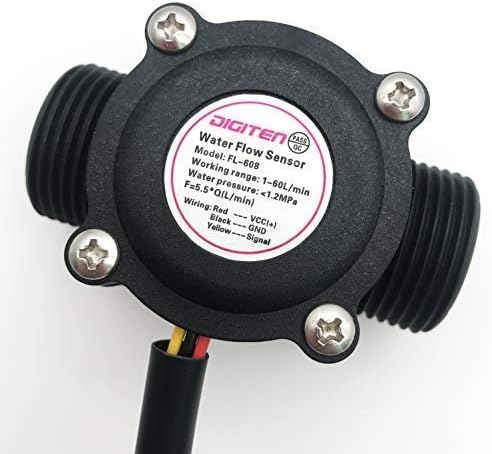
This sensor offers a robust solution for high volume water measurement projects using Arduino. With a perfect rating and wide compatibility, it stands out as the top choice for demanding tasks.
We may earn a commission when you buy through this link, at no additional cost to you.
Its large flow range of five to one hundred fifty liters per minute makes it suitable for industrial or heavy home use. The materials align with ROHS standards ensuring safety for potable water applications effectively.
While the thread may require seal tape for NPT conversion the build quality justifies the effort. The compact design allows it to fit into tight spaces without compromising accuracy or durability over time.
If you need precision and reliability for your Arduino Flow Meter setup this model delivers outstanding performance. It is highly recommended for users who prioritize quality and long-term stability in their fluid systems.
This model handles significantly higher flow rates than most competitors making it ideal for larger scale irrigation or industrial monitoring applications without sacrificing precision or control.
All components meet strict safety standards ensuring that the water flowing through the sensor remains clean and free from contaminants during measurement processes in residential settings.
We may earn a commission when you buy through this link, at no additional cost to you.
This unit provides an excellent entry point for hobbyists seeking accurate flow measurement without breaking the bank. Its lightweight design and standard thread make it very simple to integrate into existing plumbing quickly.
We may earn a commission when you buy through this link, at no additional cost to you.
The integrated magnetic hall effect sensor ensures that the electronics stay safe from water damage. It outputs electrical pulses with every revolution allowing Arduino to count and calculate flow accurately in real time.
One consideration is that it only works in one direction so installers must pay attention to the flow marker. Despite this minor constraint it remains a top contender for budget conscious DIY plumbing projects.
For those starting out with Arduino Flow Meter tasks this sensor offers the perfect balance of cost and performance. It is reliable enough for coffee machines water heaters and small scale monitoring needs perfectly.
This sensor delivers high value by combining essential features with a competitive price point making it accessible for students and hobbyists exploring fluid dynamics with microcontrollers.
The sealed sensor design ensures long life by keeping electrical components dry and isolated from the fluid stream even under constant exposure in wet environments.
We may earn a commission when you buy through this link, at no additional cost to you.
This model stands out by including a substantial cable that allows you to place the sensor further from your microcontroller. It is waterproof and designed for potable water making it versatile for many home applications.
We may earn a commission when you buy through this link, at no additional cost to you.
The extra length simplifies installation in tight or awkward spaces where reaching the Arduino board directly would be difficult. The output waveform is a clean square wave that microcontrollers can read without noise interference.
Although it carries a slightly higher price tag the convenience of the pre attached cable saves time and avoids messy splicing jobs. It is a solid premium option for those valuing ease of use.
If you want a polished setup for your Arduino Flow Meter project this sensor is an excellent choice. It combines safety durability and convenience in a package that is ready for immediate integration.
The included long cable lets you mount the sensor in hard to reach areas while keeping the wiring connections near your controller board for cleaner and more manageable projects.
Compliant with ROHS standards this sensor is safe to use with drinking water systems ensuring that your measurements do not compromise the quality of the fluid you are monitoring.
We may earn a commission when you buy through this link, at no additional cost to you.
With an impressive rating this sensor is a strong contender for applications requiring a reliable control switch alongside measurement. It is primarily used for water testing and cooling systems where signal strength matters.
We may earn a commission when you buy through this link, at no additional cost to you.
The high amplitude output ensures that the signal is robust enough to be detected reliably even in noisy environments. This makes it a great choice for industrial or semi professional setups needing consistent data.
While it is limited to a specific flow range its performance within that band is excellent. Users looking for a switch that can handle high electric strength will find this unit highly satisfactory for their needs.
Choose this unit if you need a reliable flow measurement device for cooling systems or vending machines. It provides accurate feedback and strong electrical signals that work well with various Arduino controllers.
This model delivers high voltage amplitude which reduces signal loss over distance and ensures stable communication with your microcontroller even in less than ideal wiring conditions.
Designed to withstand the rigors of cooling systems it maintains accuracy and durability under continuous flow conditions typical in server rooms or workshop machinery.
We may earn a commission when you buy through this link, at no additional cost to you.
This sensor is built with food grade plastic making it suitable for use in drinking water or beverage machines. It offers a wide voltage range which adds flexibility when choosing your power source for the project.
We may earn a commission when you buy through this link, at no additional cost to you.
The hall effect switch ensures reliable pulse generation as water flows through the unit. It is a straightforward device that integrates easily with standard plumbing and electronic systems without complex setup.
While the build is mostly plastic it is robust enough for typical household use. The rating is slightly lower than others which might indicate variability in quality but it remains a viable option for safe water projects.
For beverage machines or simple water purification systems this sensor is a solid choice. It ensures safety and provides the necessary data for your Arduino Flow Meter application to function correctly.
Constructed with materials conforming to ROHS standards this unit is safe for potable water ensuring that your drinking or beverage systems remain free from harmful contaminants.
Operating across a wide voltage range allows you to power the sensor with various power supplies making it adaptable to different project setups without needing extra regulation.
We may earn a commission when you buy through this link, at no additional cost to you.
This two pack offers a unique transparent body that lets you visually inspect the rotor and water flow at a glance. It uses stainless steel bearings for durability and works with a wide voltage range.
We may earn a commission when you buy through this link, at no additional cost to you.
The transparency is a major plus for educational projects where observing the internal mechanics is valuable. It allows users to see exactly how the flow affects the turbine which helps in understanding fluid dynamics.
However the clear plastic may be more prone to scratching or cracking under heavy pressure. The rating is lower which suggests users should handle it carefully especially if using higher water pressures.
If you need two sensors for a dual system or want to demonstrate flow mechanics this is a great pick. It is ideal for low pressure setups where visual confirmation of flow adds value to your Arduino Flow Meter build.
The transparent housing allows you to see the turbine spinning and check for debris without disassembly which is particularly useful for learning and troubleshooting fluid systems.
Buying a two pack can be more economical for projects requiring multiple monitoring points or providing a backup unit to swap out if one fails or needs calibration.
We may earn a commission when you buy through this link, at no additional cost to you.
Designed for small hosepipes this sensor fits perfectly in low volume applications. It is made of food grade plastic making it safe for drinking water and beverage dispensing tasks easily.
We may earn a commission when you buy through this link, at no additional cost to you.
The connection fits hoses with a small inner diameter which makes it ideal for portable systems or small garden setups. It is a compact unit that does not take up much space in your build.
Its pressure tolerance is relatively low so it is not suitable for high pressure municipal lines. For gentle flows however it provides reliable counting and data output for your microcontroller projects.
Choose this model for small portable setups or beverage machines where size and safety matter. It works well as an Arduino Flow Meter component in lightweight and low pressure environments.
This sensor connects directly to small inner diameter hoses making it perfect for portable pumps or irrigation lines where standard pipe fittings would be too bulky or difficult to install.
Constructed with food grade materials it ensures that the water you are measuring remains safe for consumption in home beverage machines or drinking water monitoring systems.
We may earn a commission when you buy through this link, at no additional cost to you.
This unit is optimized for water heater applications and maintains a perfect rating for reliability. It uses a hall effect sensor to detect flow changes which are fed back to the controller for regulation.
We may earn a commission when you buy through this link, at no additional cost to you.
The design ensures that the rotor assembly rotates smoothly even under the thermal conditions of a water heater. This makes it highly effective for systems where temperature and flow control are critical for safety.
While it is tailored for specific uses like water dispensers its core technology is robust. It offers clear pulse signals that are easy for Arduino to interpret and use for automated control systems.
If you are building a system for water heating or dispensing this sensor is highly recommended. It provides the precision and durability needed for an Arduino Flow Meter in thermal fluid environments.
Built to withstand the conditions found in water heaters this sensor ensures accurate flow regulation which is crucial for maintaining safe temperatures and efficient operation in heating systems.
The hall sensor provides consistent pulse signals that allow controllers to adjust heating or dispensing functions dynamically ensuring that your system responds correctly to flow changes.
We may earn a commission when you buy through this link, at no additional cost to you.
This compact sensor is designed for smaller pipe applications and offers reliable performance in tight spaces. It is waterproof and heat resistant making it suitable for a variety of household and industrial setups.
We may earn a commission when you buy through this link, at no additional cost to you.
The flow range is low but perfect for precision tasks like reverse osmosis filter monitoring. The square wave output ensures clean signals that are easy for Arduino or Raspberry Pi to process accurately.
Its small size allows for integration into systems where larger sensors would not fit. It is a practical choice for those working on projects requiring specific smaller pipe connections without compromising data quality.
Select this sensor for small scale water projects or filter systems. It serves as an effective Arduino Flow Meter component for low volume monitoring tasks with ease and precision.
This sensor is built for small pipe connections and is ideal for projects where space is at a premium allowing you to monitor flow without adding bulk to your system.
The square wave output provides a clear digital signal that simplifies coding and data processing for your microcontroller ensuring accurate flow measurement even at low rates.
We may earn a commission when you buy through this link, at no additional cost to you.
This model offers a larger flow range and includes a long cable for versatile installation. It is designed for potable water use and has a wide voltage range which makes it adaptable for many projects.
We may earn a commission when you buy through this link, at no additional cost to you.
The G3/4 connection is suitable for larger pipes than standard options giving it utility in more substantial plumbing setups. The cable helps in keeping the sensor away from the controller which can be useful.
The rating is lower which might reflect issues with specific batches or thread conversion. However for users who need the larger size and cable this can still be a viable option for certain applications.
Consider this unit for projects requiring larger flow rates and easy wire routing. It acts as a capable Arduino Flow Meter for systems where standard sizes are insufficient for your needs.
With a range up to sixty liters per minute this sensor handles significantly higher volumes than standard household units making it suitable for larger scale plumbing or irrigation setups.
The included long cable allows you to route wires cleanly to your controller which reduces clutter and simplifies installation in complex or distant system setups.
We may earn a commission when you buy through this link, at no additional cost to you.
Selecting the right Arduino Flow Meter involves understanding your specific needs regarding flow rate and pipe size.
The flow rate range is critical because each sensor handles a specific volume of water per minute. If you choose a sensor with a range that is too low for your application it may fail to provide accurate data or could be damaged by high pressure.
Always calculate your maximum expected flow rate and pick a sensor that comfortably exceeds that value for accurate results.
Most sensors use standard thread types like G1/2 or NPT. It is vital to match the sensor connection to your plumbing pipe size or use adapters correctly. Mismatched threads can lead to leaks or improper installation.
Check the connection size on your pipes before buying to ensure a snug and leak free fit without excessive extra adapters.
Arduino boards often operate at 5V while some sensors support wider ranges like 5-24V. Ensure your sensor matches your power supply to avoid hardware damage or erratic readings. A wider voltage range gives you more flexibility in wiring setups.
Verify the voltage range of your sensor against your microcontroller power supply before making a purchase.
If you are measuring drinking water or for fluids you must choose sensors made from food grade materials. Look for ROHS certification to ensure that the plastic and components will not leach harmful substances into the water.
Prioritize ROHS compliant and food grade plastics for any application involving human consumption of the measured fluid.
Some sensors come with an attached cable while others do not. A longer cable can simplify installation in tight spaces by allowing you to keep the sensor away from your controller. Without a cable you may need to add your own wiring which adds complexity.
Choose a sensor with an integrated cable if your build requires distance between the sensor and the microcontroller.
Most hall effect sensors are directional and require water to flow in a specific direction to work correctly. Installing the sensor backwards will result in no signal output and can cause issues. Always check the flow arrow on the body before attaching.
Follow the flow direction marker on the sensor housing to ensure it generates the correct signal for your system.
Each sensor has a maximum pressure limit often around 1.75 MPa for standard models. Exceeding this limit can crack the plastic body or damage the rotor assembly. Ensure your water pressure stays within the recommended limits for longevity.
Verify the pressure rating on the product specifications to prevent physical damage to the sensor unit during operation.
These sensors typically output square wave pulses that are easy for Arduino to count. Understanding how to read these pulses via interrupts is key. Some models have better signal clarity which reduces noise and improves measurement accuracy.
Look for sensors that offer clean square wave signals to simplify your code and improve the accuracy of your flow data.
Install the sensor in a section of pipe where water flows in the direction indicated by the arrow. Use thread seal tape on metal connections to prevent leaks and ensure a tight fit. Mount it firmly to avoid vibration affecting the rotor.
Connect the signal wire to a digital interrupt pin on your Arduino board. Use the provided library or write a basic sketch to count pulses over time. Calculate the flow rate using the pulse factor provided in the sensor documentation.
Regularly check the sensor for mineral buildup or debris that could block the rotor. If it loses accuracy clean it with mild vinegar solution or replace it if damaged. Keep electrical connections dry to ensure a long working life.
An Arduino Flow Meter is a sensor that measures the rate of fluid flow and outputs digital pulses to an Arduino. These pulses are counted by a script to calculate total volume or flow rate accurately.
Yes many models are made with food grade plastic and comply with ROHS standards. Always check the product details for potable water certification before using it in drinking water systems.
Connect the VCC to 5V, GND to ground, and the signal wire to a digital interrupt pin like pin 2 or 3. You will need to write code to capture the pulses and convert them into flow data.
Common flow ranges are from 0.3 liters per minute to 150 liters per minute depending on the model. Choose a model that matches the maximum flow you expect in your project.
Yes these sensors are compatible with Raspberry Pi and other microcontrollers. The logic level is usually safe for 5V GPIO pins but ensure you check voltage limits before connecting.
Check if the water is flowing in the correct direction marked by an arrow. Also verify your wiring and ensure the power supply is within the sensor's specified voltage range.
You can use standard libraries like the FlowMeter library or write custom code. There are many open source examples available online that help you interpret the pulse signals easily.
Most have an accuracy of around plus or minus 2 percent. They are generally precise enough for DIY and semi industrial use but might vary slightly over time.
We reviewed ten top options ranging from compact low flow models to high capacity industrial units. The DIGITEN G1.5 inch model stands out for its range while the budget friendly NPT option is great for beginners.
Prioritize flow range and material safety when making your decision. Ensure the thread size matches your plumbing to avoid installation headaches and choose a voltage range that fits your power supply.
Prices and availability can change so verify the current details before buying. Check the reviews and ratings to confirm that the unit meets your project requirements for reliable data.