
AMD Ryzen 9 9900X
4.8Editor score
12 Cores 24 Threads
Zen 5 Architecture
DDR5-5600 Support
Discover the top CPUs for machine learning optimized for AI workloads performance efficiency, and local model processing across desktop and developer platforms.
Choosing the right CPU for machine learning requires balancing core count, cache size, and specialized AI acceleration capabilities. Modern workloads demand robust parallel processing to handle training and inference efficiently without bottlenecks.
This guide compares ten leading processors and desktop systems designed for AI development. We evaluate architecture, memory bandwidth, thermal design, and ecosystem support to help you find the optimal hardware for your projects.
Each selection highlights specific strengths ranging from budget-friendly cores to enterprise-grade supercomputers. Prices and availability fluctuate frequently so verify current listings before finalizing your purchase decision.
4.8Editor score

4.4Editor score

5.0Editor score
The following table presents a side-by-side comparison of all ten products. It highlights core counts, architecture details, memory specifications, and intended use cases to simplify your evaluation process.


This dual-pack desktop supercomputer delivers enterprise-grade AI capabilities directly to your workspace. With a perfect rating it stands out for enabling massive model experimentation locally.
We may earn a commission when you buy through this link, at no additional cost to you.
The Grace Blackwell architecture supports up to 200 billion parameters at FP4 providing unprecedented throughput for fine-tuning and inference tasks without cloud latency.
While the investment is significant the ROI comes from faster iteration cycles and reduced dependency on external data centers for sensitive proprietary workloads.
Ideal for research teams and developers needing secure high-performance computing power the NVIDIA DGX Spark 2 Pack sets the new standard for local AI innovation.
Develop locally and deploy anywhere with the full NVIDIA AI software stack pre-integrated into the hardware for effortless workflow setup.
Experiment with models up to 200 billion parameters directly on desktop unlocking new possibilities for rapid prototyping and validation.
We may earn a commission when you buy through this link, at no additional cost to you.
Built on Zen 5 technology this processor excels in gaming and mixed-use scenarios where single-thread performance matters. It offers a compelling balance of speed and efficiency.
We may earn a commission when you buy through this link, at no additional cost to you.
The Next Gen 3D V-Cache delivers better thermal performance allowing higher clock speeds up to 5.2GHz which benefits latency-sensitive applications and simulations.
While optimized for gaming its architecture can support lighter machine learning tasks where high frequency outweighs massive parallel core counts.
For users prioritizing raw speed and platform longevity on AM5 this chip provides excellent value despite the lack of an included cooling solution.
The 96MB L3 cache improves data access times enhancing system responsiveness during complex multitasking and compute-intensive operations.
Drop-in ready for Socket AM5 infrastructure ensures future upgrade paths and compatibility with the latest DDR5 memory standards.
We may earn a commission when you buy through this link, at no additional cost to you.
This processor leverages Intel's performance hybrid architecture to prioritize workloads efficiently ensuring your PC runs cooler and quicker. It targets users seeking ultra-efficiency without sacrificing speed.
We may earn a commission when you buy through this link, at no additional cost to you.
With 24 cores including 8 P-cores and 16 E-cores it distributes tasks intelligently. The unlocked 5.7GHz speed allows for further tuning by enthusiasts.
Although designed for general desktop efficiency its core count can support parallel processing tasks though specialized AI accelerators remain better for heavy models.
Ideal for creators needing a versatile workstation this CPU balances performance and power consumption while supporting next-gen PCIe 5.0 storage and networking.
Integrates two microarchitectures to distribute workloads optimizing performance based on task requirements for better overall system efficiency.
Supports PCIe 5.0 and 4.0 ensuring future readiness for high-speed storage and peripheral connections essential for data-heavy workflows.
We may earn a commission when you buy through this link, at no additional cost to you.
Designed for gaming and content creation this 16-core processor brings Zen 5 power to desktops. It handles heavy multitasking and rendering with ease.
We may earn a commission when you buy through this link, at no additional cost to you.
Max boost clocks up to 5.7GHz ensure responsive performance even when multiple threads are active. The Granite Ridge AM5 architecture offers modern reliability.
For machine learning pre-processing tasks or CPU-bound simulations this core density provides significant advantages over fewer core alternatives.
Content creators and developers needing raw multithreaded power will find this processor a strong upgrade path over previous generation Ryzen models.
The Zen 5 architecture delivers improved IPC and efficiency enabling better throughput for complex computational tasks.
Socket AM5 platform ensures compatibility with future CPUs and DDR5 memory for long-term system viability.
We may earn a commission when you buy through this link, at no additional cost to you.
Offering 12 cores and 24 threads based on Zen 5 this processor is a top budget choice for gaming and productivity. It delivers ultra-fast performance in popular titles.
We may earn a commission when you buy through this link, at no additional cost to you.
With a max boost of 5.6GHz and 76MB cache it provides ample headroom for multitasking. Support for DDR5-5600 ensures memory bandwidth keeps pace.
Its unlocked nature allows enthusiasts to push performance further though additional cooling is required. For the price the core count is unmatched in this tier.
For developers needing a cost-effective entry into high-thread workloads this chip balances performance and affordability better than most competitors.
Delivers 100+ FPS in popular games ensuring smooth experiences even while running background development or simulation tasks.
Compatible with Socket AM5 to support PCIe 5.0 on select motherboards for faster storage and peripheral speeds.
We may earn a commission when you buy through this link, at no additional cost to you.
This 8-core processor provides dependable fast execution with maximum efficiency. Its 5nm process technology ensures reliable performance with maximum productivity for various tasks.
We may earn a commission when you buy through this link, at no additional cost to you.
With 96MB L3 cache it achieves excellent hit rates for short access times improving system responsiveness. The 4.20GHz clock speed ensures fast instruction execution.
While older than the 9000 series it remains a viable option for light compute workloads where efficiency matters more than raw throughput.
Users needing a stable and efficient processor for general development and multitasking will appreciate its reliability and low thermal footprint.
The 5nm process delivers reliable performance with maximum productivity ensuring lower power consumption during sustained workloads.
8MB L2 plus 96MB L3 cache provides excellent hit rates enabling improved system performance for frequently accessed data.
We may earn a commission when you buy through this link, at no additional cost to you.
Built for local AI development this platform features 128GB unified memory and support for massive models. It allows building intensive workloads directly on the device.
We may earn a commission when you buy through this link, at no additional cost to you.
The Ryzen AI Max+ 395 processor includes 16 cores 32 threads and an NPU delivering up to 50 TOPS for inference tasks. Full ROCm support ensures compatibility.
While the Linux OS and high price limit its audience it is purpose-built for developers needing a dedicated local inference and training environment.
For researchers validating models locally without cloud dependency the compact connected design and high-speed LPDDR5x memory provide a robust foundation.
128GB LPDDR5x memory at 8000 MT/s provides a shared pool across CPU GPU and NPU supporting larger AI models efficiently.
Includes preloaded tools models and workflows optimized for local AI development to accelerate prototyping and testing.
We may earn a commission when you buy through this link, at no additional cost to you.
This 14th Gen processor offers 24 cores and 32 threads for gaming and productivity. Its leading max clock speed of 6.0GHz ensures smooth gameplay and rapid responsiveness.
We may earn a commission when you buy through this link, at no additional cost to you.
Compatible with 600 and 700 series chipsets it cuts load times and gives space for demanding applications. DDR4 and DDR5 support adds flexibility for upgrades.
While excellent for general workloads its power demands require robust cooling solutions to maintain stability under continuous heavy loads.
Developers needing raw speed without specialized AI features will find this a strong contender for high-frequency tasks like data preprocessing and code compiling.
Leading max clock speed of up to 6.0GHz gives you smoother gameplay higher frame rates and rapid responsiveness across apps.
DDR4 and DDR5 platform support cuts your load times and gives you the space to run the most demanding games and workloads.
We may earn a commission when you buy through this link, at no additional cost to you.
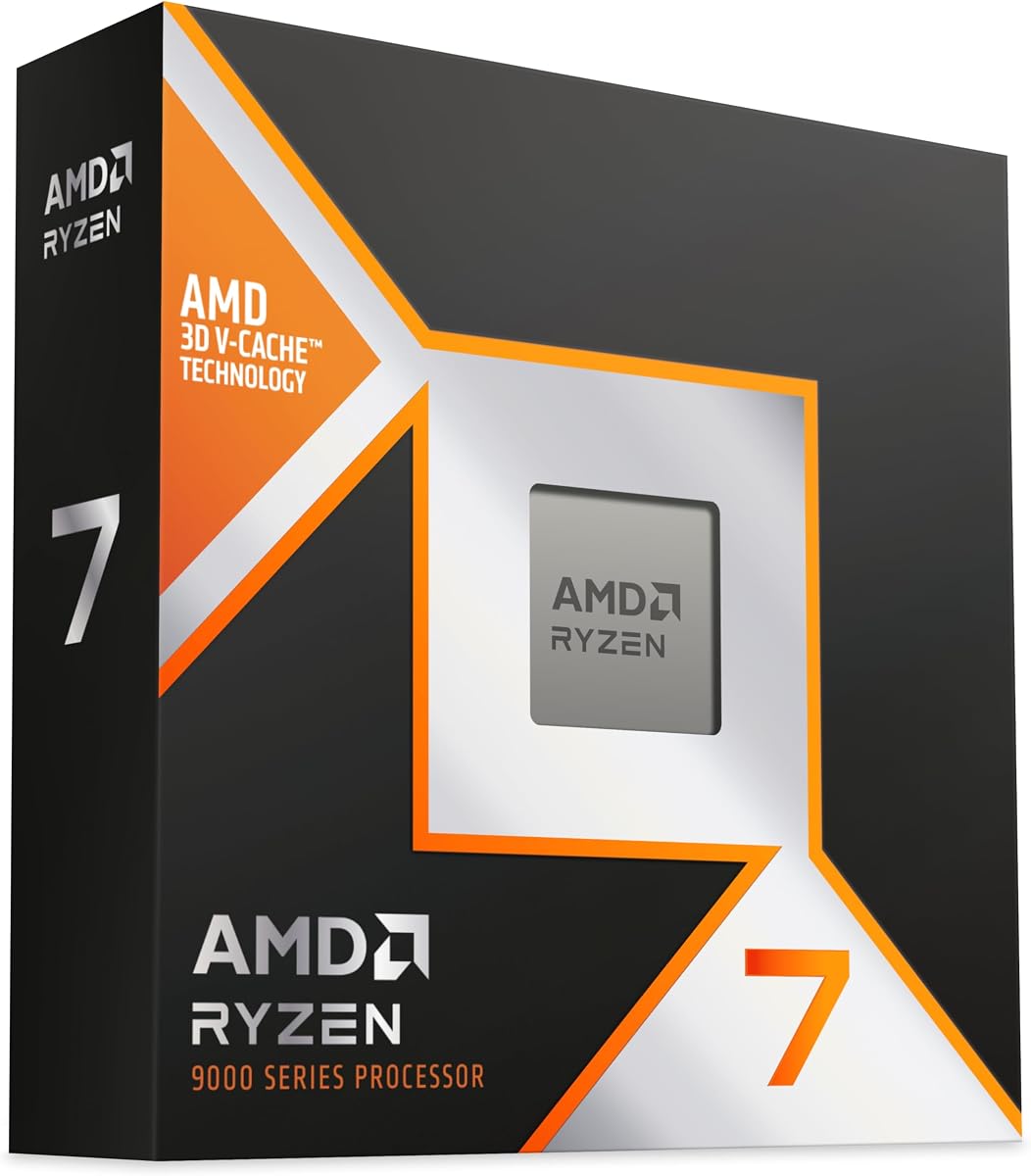
This desktop processor brings the power of Ryzen 7 and X3D technology to the AM5 platform. It is designed for users seeking top-tier performance.
We may earn a commission when you buy through this link, at no additional cost to you.
The X3D variant typically offers enhanced cache for lower latency which benefits compute-intensive applications. It unlocks potential for significant speed gains.
As a next-gen chip it represents a strong option for those investing in future-proof hardware for complex workloads and simulation tasks.
For gamers and developers who prioritize raw processing power and advanced cache features this processor delivers strong performance in demanding scenarios.
Part of the highly capable Ryzen 7 series ensuring balanced performance for both gaming and professional development tasks.
Unlocked performance allows enthusiasts to push clock speeds beyond factory settings for tailored throughput requirements.
We may earn a commission when you buy through this link, at no additional cost to you.
This single unit brings enterprise-scale AI to your desk. It delivers 1 petaFLOP of performance for local model fine-tuning and analytics accelerating your time to solution.
We may earn a commission when you buy through this link, at no additional cost to you.
Designed from the ground up to run AI it integrates the full NVIDIA software stack. Developers can prototype locally and deploy anywhere seamlessly.
The compact design saves space while augmenting cloud resources with local power for increased productivity. It enables testing models with 200 billion parameters.
For labs and developers needing secure local iteration without cloud dependency this desktop supercomputer offers exceptional ROI and innovation potential.
Use NVIDIA DGX Spark to unlock new ideas and experiment with large models directly on your desktop with 128GB of unified memory.
Seamless integration of the full NVIDIA AI software stack ensures you can develop locally and deploy anywhere effortlessly.
We may earn a commission when you buy through this link, at no additional cost to you.
Selecting a processor for machine learning involves evaluating core counts cache sizes and AI acceleration features that align with your specific workload demands.
Higher core counts allow for better parallel processing which is essential for training models and running heavy simulations. Look for CPUs with at least 8 cores for moderate tasks and 16 or more for heavy workloads.
Prioritize models with higher thread counts to maximize multitasking efficiency across multiple training jobs.
Large L3 cache reduces latency when accessing frequently used data significantly improving performance for inference and data preprocessing. X3D variants with stacked cache are particularly effective for data-heavy tasks.
Opt for processors offering 64MB or more of L3 cache if you deal with large datasets regularly.
Modern CPUs include dedicated NPUs or integrated GPUs to offload AI tasks from the main cores. These units can handle inference workloads efficiently without overloading the CPU.
Check for specific mentions of TOPS ratings or integrated graphics capable of supporting AI software frameworks like ROCm.
Fast memory bandwidth is crucial for feeding data to the processor cores quickly. DDR5 support with high speeds ensures your CPU does not stall waiting for data from RAM.
Select systems that support high-speed DDR5 modules to maintain smooth performance during long training sessions.
Ensure the CPU supports your current motherboard chipset and RAM type to avoid expensive upgrades. AM5 and modern Intel socket platforms offer the best longevity and feature sets.
Verify compatibility with your existing BIOS and cooling solutions before purchasing to ensure a smooth installation.
High performance comes with high heat output so check the TDP to ensure your cooling solution can handle sustained loads. Efficient architectures help manage heat and power usage.
Invest in robust cooling if you plan on overclocking or running the CPU at maximum boost frequencies continuously.
Some platforms offer better software support for AI frameworks and libraries. Integrated software stacks simplify deployment and reduce configuration time for developers.
Choose processors backed by active software communities and official support for tools like PyTorch or TensorFlow.
Consider how long you plan to keep the system before needing an upgrade. Newer architectures typically offer better efficiency and feature sets that extend the useful life of the hardware.
Prioritize newer generation chips with upgrade paths for better long-term value and performance stability.
Install the latest drivers and BIOS updates to ensure the processor runs at peak efficiency and supports new instruction sets for AI tasks.
Monitor temperatures regularly using system tools to prevent thermal throttling which can slow down model training and reduce hardware longevity.
Keep the system clean and free of dust to maintain optimal airflow and cooling performance especially during long processing sessions.
Not necessarily but specialized CPUs offer better parallel processing and cache for inference. Standard high-core processors work well for many general tasks while dedicated units excel at massive models.
Larger cache stores frequently accessed data closer to the core reducing latency. This improves throughput for data-heavy workflows like preprocessing and model inference significantly.
Both excel depending on specific needs. AMD often leads in efficiency and core counts while Intel offers strong hybrid architecture and integration with certain software ecosystems.
Yes high-end desktop CPUs with unified memory support can run large models locally. However training massive models often benefits from dedicated GPU or server resources.
DDR5 speeds of 5600 MT/s or higher are ideal to feed data quickly. Faster memory bandwidth ensures your CPU cores do not wait for data inputs.
Linux is the standard for most AI frameworks. Preloading Linux simplifies development workflows and removes OS compatibility issues for researchers and developers.
Yes effective cooling prevents thermal throttling which reduces clock speeds under load. Proper cooling ensures your CPU maintains peak performance during long training sessions.
Look for 12+ cores with DDR5 support and good single-core speeds. Budget options like the 9900X offer excellent value for moderate development and inference tasks.
The NVIDIA DGX Spark series leads for enterprise-grade local AI while the AMD Ryzen 9 9900X offers strong budget performance for developers needing core count.
Prioritize memory bandwidth and architecture efficiency over raw clock speed if your workflows involve heavy data processing and simultaneous model training tasks.
Prices and specs change frequently so check current listings and user reviews to confirm the latest offers before finalizing your purchase decision.