
RIGOL DHO924S Oscilloscope
4.5Editor score
250MHz bandwidth with 4 channels
Built-in signal generator and Bode plot
12-bit resolution and 50Mpts memory
Digital oscilloscopes are essential tools for visualizing electronic signals and troubleshooting circuits. Whether you are an engineer or a hobbyist, choosing the right scope ensures accurate measurements and efficient debugging across various applications.
We evaluated ten leading models based on key specifications like bandwidth, sampling rate, memory depth, and user interface. This list covers entry-level handheld units to advanced desktop scopes with integrated signal generation and protocol analysis capabilities.
Each pick highlights specific strengths and ideal use cases to guide your decision. Please note that prices and availability may change, so verify current details before purchasing to ensure you get the best value for your needs.
4.5Editor score

4.9Editor score

4.4Editor score
As an Amazon Associate we earn from qualifying purchases.
The following table provides a side-by-side comparison of all ten models, highlighting their core specifications to help you quickly identify the device that best fits your technical requirements and budget.
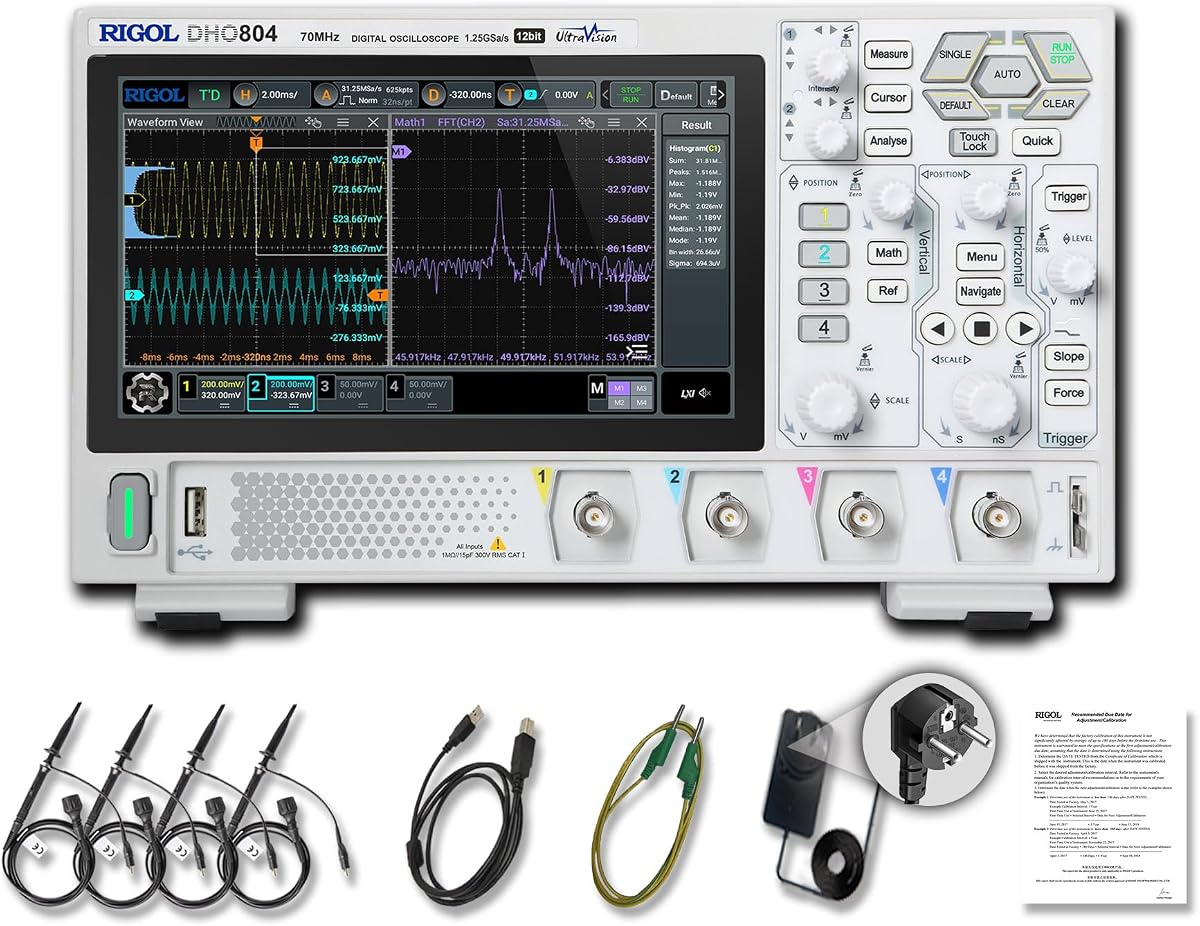


The RIGOL DHO804 offers exceptional value with its 12-bit resolution and 70MHz bandwidth, making it ideal for detailed signal analysis.
We may earn a commission when you buy through this link, at no additional cost to you.
Its UltraAcquire system provides up to one million waveforms per second, helping you spot intermittent glitches quickly during testing.
While it may be pricier than entry-level models, the deep memory and serial decode options justify the cost for serious engineers.
This scope is perfect for embedded systems work where fine vertical detail and protocol troubleshooting are critical for success.
The 12-bit vertical resolution provides significantly more detail than standard 8-bit scopes, allowing you to see small voltage variations clearly.
Built-in support for CAN, I2C, and SPI decoding simplifies debugging complex digital systems without needing external analysis tools.
We may earn a commission when you buy through this link, at no additional cost to you.
The DHO924S brings high-end features like a built-in function generator and 250MHz bandwidth to desktop testing environments efficiently.
We may earn a commission when you buy through this link, at no additional cost to you.
Its 12-bit resolution and 50Mpts memory allow for capturing long records of high-speed signals with fine detail.
Although the digital channel probe is sold separately, the Bode plot analysis makes this a powerful choice for loop testing.
Buy this if you need professional-grade performance for power supply and high-speed embedded timing validation tasks.
The included AFG allows for Bode plot testing from 10Hz to 25MHz, simplifying loop stability checks without extra gear.
With 50Mpts memory depth, you can capture longer time records while maintaining high sample rates for detailed edge analysis.
We may earn a commission when you buy through this link, at no additional cost to you.
This model packs a 350MHz bandwidth and signal generator into a portable handheld unit, making it a versatile option for field work.
We may earn a commission when you buy through this link, at no additional cost to you.
It features a frequency response analyzer and FFT capabilities that are rare at this price point, offering robust analysis tools.
The limited memory depth might restrict long captures, but the bandwidth and battery life suit most troubleshooting scenarios effectively.
Get this if you need high-frequency testing capabilities in a battery-powered device without paying for a full desktop rig.
Built-in frequency response analysis allows for loop stability testing and filter tuning without needing external equipment.
The DDS signal generator outputs up to 50MHz, enabling direct signal injection and circuit stimulation on the go.
We may earn a commission when you buy through this link, at no additional cost to you.
The DS1102Z-E is a proven workhorse with a 4.9 rating, offering deep memory and reliable waveform capture for diverse tasks.
We may earn a commission when you buy through this link, at no additional cost to you.
Its 24Mpts memory allows for capturing long sequences at high sample rates, which is critical for modern embedded debugging.
While it lacks four channels and touchscreen features, its stability and serial decode support make it a top choice for labs.
It is the ideal pick for students and professionals who prioritize reliability and memory depth over advanced multimedia features.
With 24Mpts of memory, you can view long time captures while maintaining detailed sample rates for glitch analysis.
Hardware recording and playback support up to 60,000 frames, enabling detailed event review after a test sequence.
We may earn a commission when you buy through this link, at no additional cost to you.
This device combines a 50MHz scope, multimeter, and signal generator into one compact package for basic electronics troubleshooting.
We may earn a commission when you buy through this link, at no additional cost to you.
The 4.5-digit multimeter and signal generator add significant utility, making it a great all-in-one tool for hobbyists.
While the bandwidth is limited, the ability to save waveforms and use auto measurements makes it user-friendly for beginners.
Choose this if you want a portable toolkit that covers voltage, current, and basic signal analysis without multiple devices.
Combining a scope, multimeter, and generator reduces the need for multiple bench instruments, saving space and cost.
You can save and export waveform images via Type-C, facilitating easy sharing and documentation of test results.
We may earn a commission when you buy through this link, at no additional cost to you.
The DSO152 is an incredibly affordable handheld oscilloscope perfect for hobbyists needing to see basic analog and digital signals.
We may earn a commission when you buy through this link, at no additional cost to you.
Its pocket size and built-in battery allow it to be used anywhere, making it great for quick checks in the field.
While the 200kHz bandwidth is low, it handles audio and slow logic signals well, offering good value for the price.
This is the best entry-level choice for those just starting out who do not need high-frequency signal analysis capabilities.
Weighing just a few ounces, this unit fits in a pocket and runs for hours on a single charge for field use.
The one-key auto setting simplifies waveform display, requiring minimal adjustment to get a clear view of signals.
We may earn a commission when you buy through this link, at no additional cost to you.
Hantek offers a solid mid-range option with 150MHz bandwidth and arbitrary waveform generation for a reasonable price.
We may earn a commission when you buy through this link, at no additional cost to you.
It supports various trigger modes and serial protocol decodes, making it suitable for embedded systems and communication debugging.
While the display is basic, the performance and feature set provide good value for general lab use without premium costs.
Select this scope if you need more bandwidth than entry-level models but do not require four-channel analysis capabilities.
The built-in arbitrary waveform generator allows for custom signal creation, useful for testing and circuit stimulation.
Standard serial protocol triggers help identify timing issues in communication systems quickly and efficiently.
We may earn a commission when you buy through this link, at no additional cost to you.
This model features a large 7-inch touchscreen that simplifies interaction and viewing compared to standard knob-based scopes.
We may earn a commission when you buy through this link, at no additional cost to you.
Its waveform image manager stores up to 1000 screenshots and data sets, helping you keep track of your testing progress.
The 6000 mAh battery ensures long usage times, making it a convenient portable option for bench or field work.
Ideal for users who prefer touch gestures and need robust local storage for their waveform and test images.
The capacitive touch screen allows for easy gesture operations, making parameter adjustments and zooming more intuitive.
Thumbnail browsing and detailed viewing options make it easy to review past tests without needing external storage.
We may earn a commission when you buy through this link, at no additional cost to you.
This product entry currently lacks verified details, so please check the listing directly for accurate specifications and features.
We may earn a commission when you buy through this link, at no additional cost to you.
Without confirmed data, it is impossible to provide a detailed analysis or rating at this time for this model.
Ensure you review customer feedback and seller information carefully to confirm if this unit meets your specific needs.
We recommend focusing on models with verified specifications to ensure you receive a reliable and tested digital oscilloscope.
Always check the current product details and seller ratings to ensure the device meets your expectations.
Review other options in this list to find a scope with clear specs and reliable performance.
We may earn a commission when you buy through this link, at no additional cost to you.
Selecting the right oscilloscope requires understanding your specific measurement needs and technical requirements.
Bandwidth determines the highest frequency signal the scope can accurately measure. For digital signals, choose a scope with bandwidth at least five times higher than your signal frequency to avoid distortion.
Prioritize bandwidth that matches your fastest signal edges to ensure clean measurements.
Sampling rate defines how many points the scope captures per second. Higher rates provide more detail and better rise time measurements, essential for high-speed designs.
Ensure the sampling rate meets the Nyquist criterion for your signals to prevent aliasing issues.
Memory depth affects how long you can capture signals at high sampling rates. Deep memory allows for viewing long records without losing detail, critical for complex debugging.
Look for scopes with sufficient memory to cover your longest time window of interest.
Channels allow you to monitor multiple signals simultaneously. Two channels are enough for simple circuits, but four channels provide flexibility for power rails and timing checks.
Choose at least as many channels as your typical debugging scenarios require.
Resolution in bits indicates vertical detail. Standard 8-bit scopes work for most tasks, but 12-bit models reveal smaller signal variations and noise components clearly.
Higher resolution is beneficial when measuring low amplitude signals or power supply ripple.
Ports like USB, LAN, and HDMI simplify data export and remote control. LAN and Web Control enable automation and documentation workflows in larger labs.
Ensure the device supports your preferred interface standards like SCPI for automation.
Handheld units offer battery power and compact designs for field work, while desktop models provide more features and performance. Consider where you will use the scope most often.
Portable scopes are ideal for on-site troubleshooting where mains power is unavailable.
Built-in signal generators, protocol decoders, and math functions add value. These tools reduce the need for extra instruments and streamline your testing process.
Select features that match your specific application requirements like CAN bus or FFT analysis.
Always ground the oscilloscope properly and check probe calibration before measuring to ensure safety and accuracy. Use probes rated for the voltage levels of your circuit to avoid damage.
Utilize auto-setup functions to quickly display waveforms, then refine settings like time base and trigger for detailed analysis. Save screenshots and data regularly to track your progress.
Store your scope in a dry place and protect it from extreme temperatures. Clean the screen and inputs gently and avoid dropping probes to maintain long-term reliability.
Select a bandwidth at least five times higher than your signal frequency for accurate measurements. For example, a 100MHz scope is ideal for signals up to 20MHz to prevent distortion.
Many handheld models offer solid performance for field work and basic debugging. High-end handhelds can handle detailed signal analysis, though desktop units may provide better specs.
Digital scopes sample signals for precise measurements and storage while analog scopes show continuous waveforms. Digital models offer better analysis tools and are standard for modern electronics.
Deep memory allows you to capture long time records without reducing sample rate. This helps you find rare glitches and analyze complex timing sequences effectively.
Yes, modern scopes function standalone with built-in displays and storage. However, connecting to a PC can enhance data management and remote control capabilities.
Use the built-in calibration output and probes to adjust for correct amplitude and timing. Regular calibration ensures accurate measurements and prevents drift over time.
Focus on bandwidth, channel count, and protocol decoding support for CAN, I2C or SPI. Deep memory is also crucial for capturing complex digital sequences.
Yes, a 12-bit scope provides more vertical resolution and noise detail. It reveals smaller signal variations which can be critical for power and precision measurements.
Our top picks highlight the best options across performance and budget. The RIGOL DHO924S leads in features, the DS1102Z-E offers reliability, and the DSO152 provides unmatched value for beginners.
Prioritize bandwidth and memory depth based on your signal complexity. Ensure the device supports the channels and decoding tools you need for daily work.
Prices may vary so check current listings before purchasing. Selecting the right digital oscilloscope now ensures efficient testing for years to come.