
LAFVIN R3 Camera Smart Robot Car
4.5Editor score
Affordable price point
ESP32-S3 module
Five smart modes
Explore the top ten Arduino robot kits for builders of all levels. We compare features, sensors, and coding capabilities to help you choose.
Arduino robot kits offer an exciting entry point into electronics and coding for hobbyists and students alike. These programmable platforms allow you to build functional machines that can move, sense their environment, and interact with users through custom code.
We evaluated ten leading kits based on build quality, sensor variety, coding flexibility, and educational value. Our analysis considers compatibility with the Arduino IDE, assembly complexity, and the breadth of projects each platform supports for long-term learning.
Each pick highlights unique strengths such as camera integration, tank treads, or robotic arm capabilities. While prices vary significantly, all selections provide robust frameworks for STEM education. Note that availability and pricing may change over time.
4.5Editor score

4.5Editor score

4.3Editor score
The following table provides a side-by-side overview of all ten kits. It highlights key specifications to help you quickly identify the best fit for your project needs and skill level.


The ELEGOO UNO R3 Smart Robot Car Kit V4 stands out as the top pick for its comprehensive feature set. With a 4.5 rating, it delivers a balanced experience for beginners and intermediate coders looking to build a smart vehicle.
We may earn a commission when you buy through this link, at no additional cost to you.
Its standout quality is the integrated OV2640 camera paired with an ESP32-WROVER module. This setup enables live FPV streaming to your phone, allowing you to drive the car remotely while viewing its perspective in real time.
While the kit is robust, users should note that batteries are not included. Additionally, the app setup requires a stable Wi-Fi connection which can be a minor hurdle in some home networks during initial configuration.
We recommend this kit for anyone wanting a complete robotics platform without needing extra modules. It covers the essentials of line tracking, obstacle avoidance, and visual control effectively for STEM learning.
The FPV capability turns the robot into a remote exploration vehicle rather than just a line follower.
Keyed XH2.54 connectors prevent reverse wiring and make module connection foolproof for new users.
We may earn a commission when you buy through this link, at no additional cost to you.
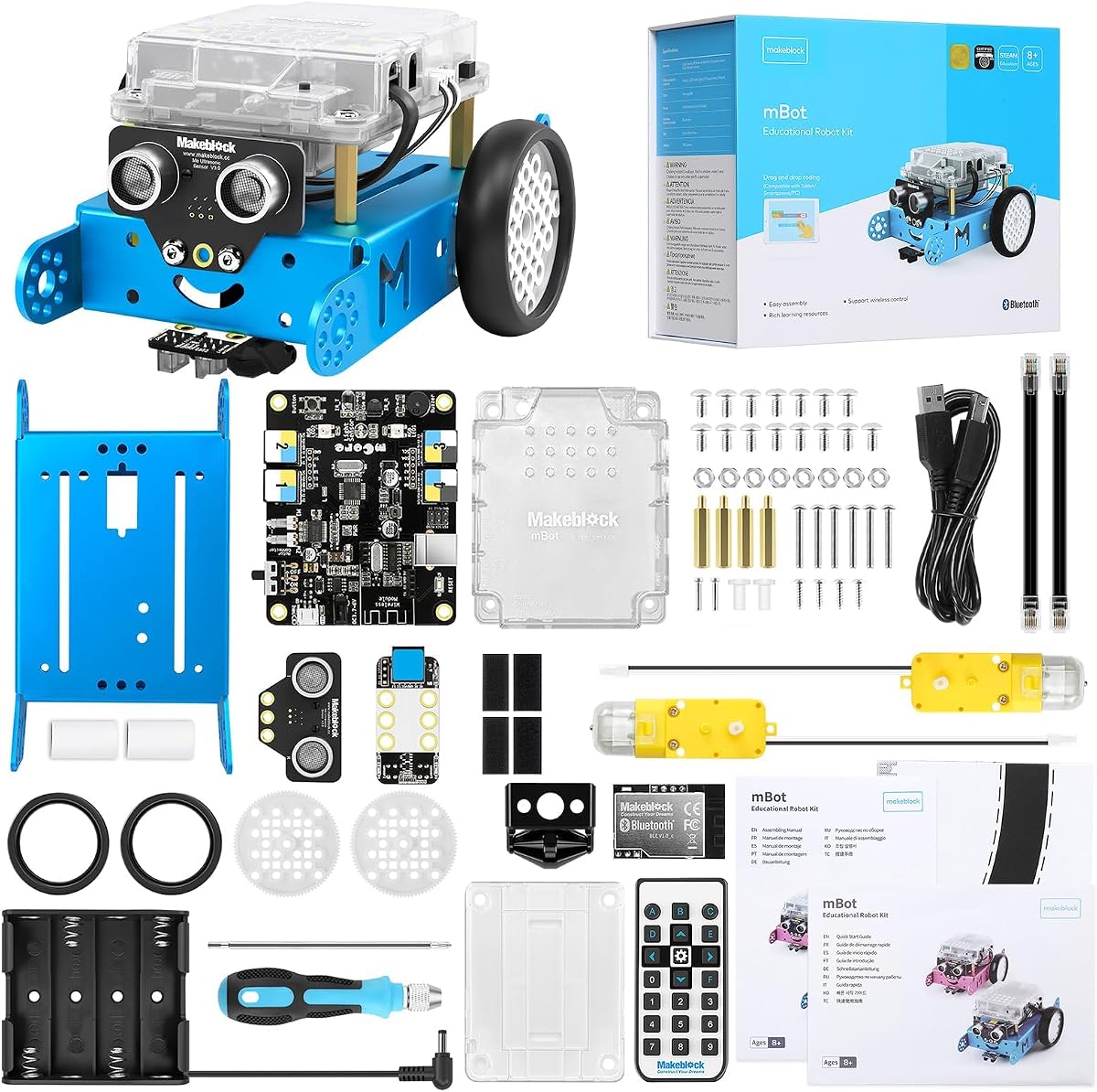
The Makeblock mBot is a classic choice for young learners. With a high 4.6 rating, it offers a straightforward path into robotics using familiar tools like Scratch and the Arduino IDE.
We may earn a commission when you buy through this link, at no additional cost to you.
Its primary strength lies in its educational progression. Kids can start with block coding and gradually move to text-based code as they learn, ensuring a smooth learning curve without overwhelming complexity.
However, the kit lacks some advanced features like cameras or complex navigation. Parents should be aware that batteries for the remote and robot are not included in the box purchase.
This kit is ideal for parents seeking a reliable first robot for children aged eight to twelve. It provides a solid foundation in mechanics and programming principles effectively.
The transition from Scratch to C++ helps students understand code structure without frustration.
Metal chassis components withstand rough handling better than plastic alternatives for younger builders.
We may earn a commission when you buy through this link, at no additional cost to you.
The Conqueror kit transforms the standard robot car into a rugged tank platform. With a 4.4 rating, it appeals to those who want more durability and better traction for outdoor or uneven surface tests.
We may earn a commission when you buy through this link, at no additional cost to you.
Its metal tracks and suspension system allow it to handle bumps and obstacles that would stop a wheeled car. The camera is mounted on a servo, giving you the ability to look around while driving.
The main trade-off is the weight and cost. This kit is significantly heavier than plastic wheel versions which might limit portability for some users or younger children.
We suggest this for students interested in heavier machinery or outdoor robotics. It teaches stability control and track mechanics alongside standard programming tasks effectively.
Track systems provide superior grip on grass or gravel compared to standard rubber tires.
Servo-tilted camera allows scanning over obstacles rather than just facing forward.
We may earn a commission when you buy through this link, at no additional cost to you.
The Tumbller kit focuses on the physics of balance. With a 4.5 rating, it serves as an excellent tool for demonstrating how sensors and motors work together to keep a machine upright.
We may earn a commission when you buy through this link, at no additional cost to you.
Its key strength is the implementation of PID control loops. Students can see how changing code parameters affects the robot's stability and movement in real time during experiments.
Building this robot requires precision wiring and careful calibration. While rewarding, it might be frustrating for absolute beginners who lack patience for debugging balance algorithms.
This kit is best suited for users ready to move beyond basic driving. It provides deep insights into feedback loops and motion control systems.
Learning how to tune proportional integral derivative constants is a valuable engineering skill.
Bounce mode lets the robot react to obstacles by flipping over and resetting itself.
We may earn a commission when you buy through this link, at no additional cost to you.
The ACEBOTT kit stands out for its Mecanum wheel configuration. With a 4.2 rating, it enables omnidirectional movement that is unique compared to standard car or tank robot designs.
We may earn a commission when you buy through this link, at no additional cost to you.
Users can move sideways or rotate in place without turning the chassis. This flexibility is perfect for navigating tight spaces or performing specific tasks like docking at precise angles.
The Mecanum rollers can wear out faster than standard tires. Additionally, this drive system works best on smooth hard surfaces rather than carpet or outdoor terrain.
We recommend this kit for users interested in advanced locomotion mechanics. It introduces a more complex control strategy that is highly rewarding when mastered.
Moving diagonally or sideways requires coordinating four motor speeds for precise motion.
Optional camera or robotic arm packs allow further customization beyond the base chassis.
We may earn a commission when you buy through this link, at no additional cost to you.
The LAFVIN R3 kit offers the most accessible entry point into camera-based robotics. With a 4.5 rating, it proves that high functionality does not always require a high price tag.
We may earn a commission when you buy through this link, at no additional cost to you.
It uses the ESP32-S3 module which supports Wi-Fi efficiently for video streaming. This modern approach ensures smoother performance compared to older modules used in competing budget kits.
Build materials are functional but not premium. Users should handle the chassis carefully as it may not withstand repeated drops or rough handling like metal kits.
We suggest this kit for students who need a camera robot without breaking the bank. It delivers core FPV features well for the price.
The ESP32-S3 ensures better Wi-Fi stability and processing power than legacy boards.
Extensive open-source resources help users troubleshoot and modify code freely.
We may earn a commission when you buy through this link, at no additional cost to you.
This ACEBOTT kit combines a robotic arm with a tank car chassis. With a 3.9 rating, it offers versatility but requires more patience to assemble the multiple components involved.
We may earn a commission when you buy through this link, at no additional cost to you.
The 5DOF arm allows for grabbing and lifting objects which adds a new dimension to standard movement robots. The tank tracks ensure it can climb over debris or ramps effectively.
Assembly involves more steps than simple car kits. Users may find the wiring and motor mounting slightly challenging without prior experience with robotics.
We recommend this for older teens who want a multi-functional robot. It is a great way to practice integrating different subsystems into one vehicle.
Adding a robotic arm teaches kinematics and servo positioning beyond simple wheel control.
Tank tracks provide better off-road capability than standard rubber tires for the arm.
We may earn a commission when you buy through this link, at no additional cost to you.
The SunFounder Ultimate Starter Kit is a comprehensive library of components. With a 4.5 rating, it focuses on teaching electronics and coding through 87 different projects rather than one single robot.
We may earn a commission when you buy through this link, at no additional cost to you.
Its strength is the detailed video courses that accompany the parts. This educational approach ensures you understand the function of each sensor and actuator used in the build.
The sheer number of items can feel overwhelming for some users. Unlike a car kit that you can assemble quickly this is a long-term learning resource requiring sustained attention.
We recommend this for those who want to learn electronics from scratch. It provides the broadest foundation for future Arduino projects beyond robotics.
Step-by-step video lessons reduce the guesswork in understanding how components interact.
Moving from simple LEDs to IoT sensors ensures a complete skill development path.
We may earn a commission when you buy through this link, at no additional cost to you.
The Makeblock mBot Ultimate is the premium choice for serious builders. With a 4.3 rating, it uses industrial-grade aluminum parts that feel more like professional engineering equipment than a toy.
We may earn a commission when you buy through this link, at no additional cost to you.
It supports the MegaPi control board which can handle complex tasks like multiple motor control and even Raspberry Pi integration. This allows for high-level machine vision and AI projects.
The cost is significant compared to other kits. However, for a durable platform that grows with your skills and supports professional coding languages it is a sound investment.
We suggest this for older teens or adults looking for a long-term robotics platform. It offers the highest ceiling for advanced experimentation.
Metal frames and precision threaded grooves ensure tight assembly and durability.
Python and Raspberry Pi compatibility opens the door to AI and machine learning.
We may earn a commission when you buy through this link, at no additional cost to you.
The Freenove Hexapod kit offers a distinct walking robot experience. With a 4.1 rating, it focuses on biomimetics and gait control rather than wheels or tracks.
We may earn a commission when you buy through this link, at no additional cost to you.
Its 18 independent servo motors allow for complex movements like climbing stairs or navigating uneven ground. The included code library handles most of the complex math for walking stability.
Assembling eighteen servos takes time and patience. Additionally the power consumption is high so frequent battery charging is needed for long sessions.
We recommend this for users fascinated by biological movement. It is a fantastic project for learning about complex servo coordination and stability.
Learning how insects walk and balance provides unique insights into motion control.
Managing 18 motors simultaneously teaches complex power and signal distribution.
We may earn a commission when you buy through this link, at no additional cost to you.
Selecting the right kit depends on your skill level, budget, and specific interests in robotics. This guide breaks down the critical factors you should consider.
Ensure the kit uses standard boards like UNO R3 or ESP32 for broad compatibility. Most kits listed support the standard Arduino IDE so you can write custom code easily.
Check for open-source support if you want to modify firmware. Standard controllers ensure you are not locked into proprietary software ecosystems.
Look for kits that include ultrasonic and line tracking sensors. These are essential for basic navigation tasks like obstacle avoidance and path following.
Advanced kits may include cameras or gyros. Decide if you need visual feedback or physical balance for your specific project goals.
Consider how much time you want to spend building. Some kits like the LAFVIN are quick to assemble while others like the Hexapod take hours.
Choose a build difficulty that matches your current experience. Too hard may discourage you while too easy may not teach enough.
Check if the kit supports both block coding and text-based C++. Start with Scratch for children then move to Arduino IDE as skills improve.
Verify available tutorials. Good documentation is crucial for troubleshooting code errors during your learning process.
Decide between wheels, tracks, or legs. Wheels are fast and easy tracks are rugged and legs are complex but versatile.
Match the mobility to your terrain. If you plan to drive on carpet or dirt choose tracks over standard rubber tires.
Choose a platform that supports add-on modules. A chassis with extra pins or slots allows you to add robotic arms or sensors later.
Look for modular designs like the Makeblock Ultimate. This ensures your investment lasts longer as your skills grow.
Check if batteries are included. Many kits require separate purchases which adds to the initial cost.
Rechargeable lithium options are convenient for long use. Ensure the kit has a proper charging port for easy power management.
Research the brand's online forums and project libraries. A strong community means more examples and faster solutions to problems.
Choose kits with active developer support. This helps you find code templates and hardware patches when needed.
Start by assembling the chassis strictly following the illustrated manual. Ensure all wires are connected to the correct ports to avoid short circuits or damage to the board.
Install the necessary software on your computer before uploading code. This includes the Arduino IDE and any specific drivers for the USB-to-serial chip on your controller board.
Regularly check the wheels and servos for smooth movement. Dust and debris can cause friction so keep the robot clean after outdoor use to extend its lifespan.
Most modern kits like the ELEGOO and LAFVIN models are designed for solder-free assembly. They use plugs and connectors to keep the build process accessible for beginners.
Many kits require separate battery purchases. Common types are AA cells for motors and Li-ion packs for the controller. Check the specific product details before buying.
Yes these kits are excellent for STEM education. They provide hands-on learning for physics math and computer science which aligns well with academic curricula.
No prior experience is needed as most kits provide starter code. You can copy sample programs and modify them gradually to learn how syntax affects robot behavior.
Some premium models like the Makeblock Ultimate support Raspberry Pi integration. Most standard kits work best with the Arduino controller which is included in the box.
Battery life varies by model usage typically ranges from one to two hours on a single charge. Heavy use of motors and cameras will drain the power faster.
We reviewed ten distinct platforms ranging from simple cars to complex walking robots. The ELEGOO UNO R3 stands out for its balance of features and ease of use for most buyers.
Prioritize your learning goals when making a final decision. If you want a durable long-term tool consider the Makeblock Ultimate. For quick fun choose the LAFVIN or ACEBOTT options.
Prices and availability fluctuate so check the current listings before purchasing. Ensure you have the necessary batteries and computer tools ready before starting your build.