
ASUS Dual GeForce RTX 5060 Ti 16GB
4.7Editor score
Blackwell architecture support
16GB GDDR7 memory
Dual BIOS profiles
This guide compares the top 10 GPUs for Davinci Resolve including NVIDIA and AMD options to help you choose the right hardware for your editing needs.
Choosing the right GPU for Davinci Resolve is essential for smooth playback and fast rendering. Modern editors need powerful hardware to handle high resolutions and complex effects without lag.
We compared ten top GPUs based on performance, memory capacity, and compatibility. This list covers options from budget-friendly to professional workstation cards suitable for various workflows.
Each pick shows key specs and strengths to help you decide. Note that availability and pricing can change quickly so verify details before purchasing your new graphics card.
4.7Editor score

4.6Editor score

4.3Editor score
This side-by-side comparison highlights the key specifications of the top ten graphics cards for Davinci Resolve to help you find the perfect match for your system.



The GIGABYTE GeForce RTX 5080 Gaming OC 16G stands out as a top choice for video editors. It offers a strong combination of memory and architecture that handles Davinci Resolve workloads with ease.
We may earn a commission when you buy through this link, at no additional cost to you.
Powered by the NVIDIA Blackwell architecture this card delivers significant performance gains. The 16GB GDDR7 memory ensures smooth playback even with high resolution footage and complex color grading nodes.
While it requires a robust power supply and comes at a higher price the performance justifies the cost. It handles real time effects and rendering tasks efficiently without bottlenecks.
This GPU is ideal for professional editors who need reliability and speed. If you work with 4K or 8K content this card will support your workflow effectively for years to come.
The NVIDIA Blackwell architecture enables faster processing of AI tools and effects within Davinci Resolve.
The WINDFORCE cooling system maintains optimal temperatures during long rendering sessions.
We may earn a commission when you buy through this link, at no additional cost to you.
The PNY NVIDIA Quadro RTX 4000 is designed for professional workflows that demand stability. It brings real time rendering capabilities that are useful for 3D work within Davinci Resolve.
We may earn a commission when you buy through this link, at no additional cost to you.
Built on the Turing architecture it includes 36 RT cores for accelerated ray tracing. This makes it suitable for editors who incorporate motion graphics and visual effects into their projects.
Compared to newer models it has less memory and slower raw performance. However for users who prioritize stability and professional certification it remains a solid option for mid range editing.
Choose this card if you need a reliable workstation component without the latest flagship cost. It serves well for 1080p and 4K editing where extreme speed is not the primary requirement.
This card is validated for professional applications ensuring stable performance in creative software.
Real time ray tracing helps visualize lighting and materials accurately during editing.
We may earn a commission when you buy through this link, at no additional cost to you.
The NVIDIA Titan RTX Graphics Card was built for heavy workloads involving AI and rendering. Its high core count provides significant horsepower for complex Davinci Resolve timelines and effects.
We may earn a commission when you buy through this link, at no additional cost to you.
With 4609 CUDA cores and 577 Tensor Cores it handles machine learning tasks efficiently. This is beneficial for users who rely on AI driven features like noise reduction or voice isolation.
It requires a substantial power supply and generates more heat than consumer cards. While performance is excellent you must ensure your system can handle the thermal and electrical demands.
This card is best for advanced users who need maximum compute power. It supports professional tasks well and remains a powerful choice for rendering and simulation work.
The Tensor Cores accelerate AI tasks helping to process content faster.
High core counts enable faster rendering of complex visual effects.
We may earn a commission when you buy through this link, at no additional cost to you.
The ASRock Radeon AI PRO R9700 Creator 32GB offers a large memory pool for demanding projects. This makes it suitable for editors working with multiple streams of 8K footage or complex 3D scenes.
We may earn a commission when you buy through this link, at no additional cost to you.
Built on AMD RDNA 4 architecture it includes dedicated AI accelerators. The PCIe 5.0 support ensures fast data transfer rates between the GPU and system memory.
While AMD drivers have improved compatibility with Davinci Resolve can favor NVIDIA. However the raw performance and memory capacity provide a strong alternative for specific workflows.
Choose this card if you need maximum memory on a professional card. It handles heavy workloads well and the blower cooler helps in multi GPU workstation environments.
32GB of VRAM allows for larger buffers and smoother playback of high resolution media.
The latest PCIe interface provides double the bandwidth for faster data throughput.
We may earn a commission when you buy through this link, at no additional cost to you.
The GIGABYTE Radeon RX 9070 XT Gaming OC 16G provides strong raw performance for the price. It is a versatile card that can handle both gaming and video editing tasks effectively.
We may earn a commission when you buy through this link, at no additional cost to you.
With 16GB of GDDR6 memory and PCIe 5.0 support it offers ample resources for 4K editing. The WINDFORCE cooling system keeps temperatures in check during extended work sessions.
While NVIDIA cards often have better optimization for Davinci Resolve AMD GPUs are catching up. This card is a good choice for budget conscious editors who still need high performance.
Consider this option if you want a balance of cost and capability. It supports modern workflows and the thermal solution ensures reliability under load.
Server-grade thermal conductive gel improves heat transfer for better cooling performance.
PCIe 5.0 ensures fast communication with the CPU for smoother data handling.
We may earn a commission when you buy through this link, at no additional cost to you.
The NVD RTX PRO 6000 Blackwell Professional Workstation is the top tier choice for professional studios. It offers massive memory and the latest features for handling the most demanding projects.
We may earn a commission when you buy through this link, at no additional cost to you.
With 96GB of DDR7 ECC memory it can store vast amounts of data locally. This eliminates bottlenecks when working with high resolution raw footage or complex 3D environments.
This card is designed for enterprise environments where reliability and performance are critical. It supports multi GPU setups and provides secure isolation for different users or tasks.
Invest in this GPU if you run a production facility or need the best available. It future proofs your system against upcoming software demands and heavy workloads.
96GB of memory allows for complex projects without swapping to slower system RAM.
MIG technology divides the GPU into instances for better resource management.
We may earn a commission when you buy through this link, at no additional cost to you.
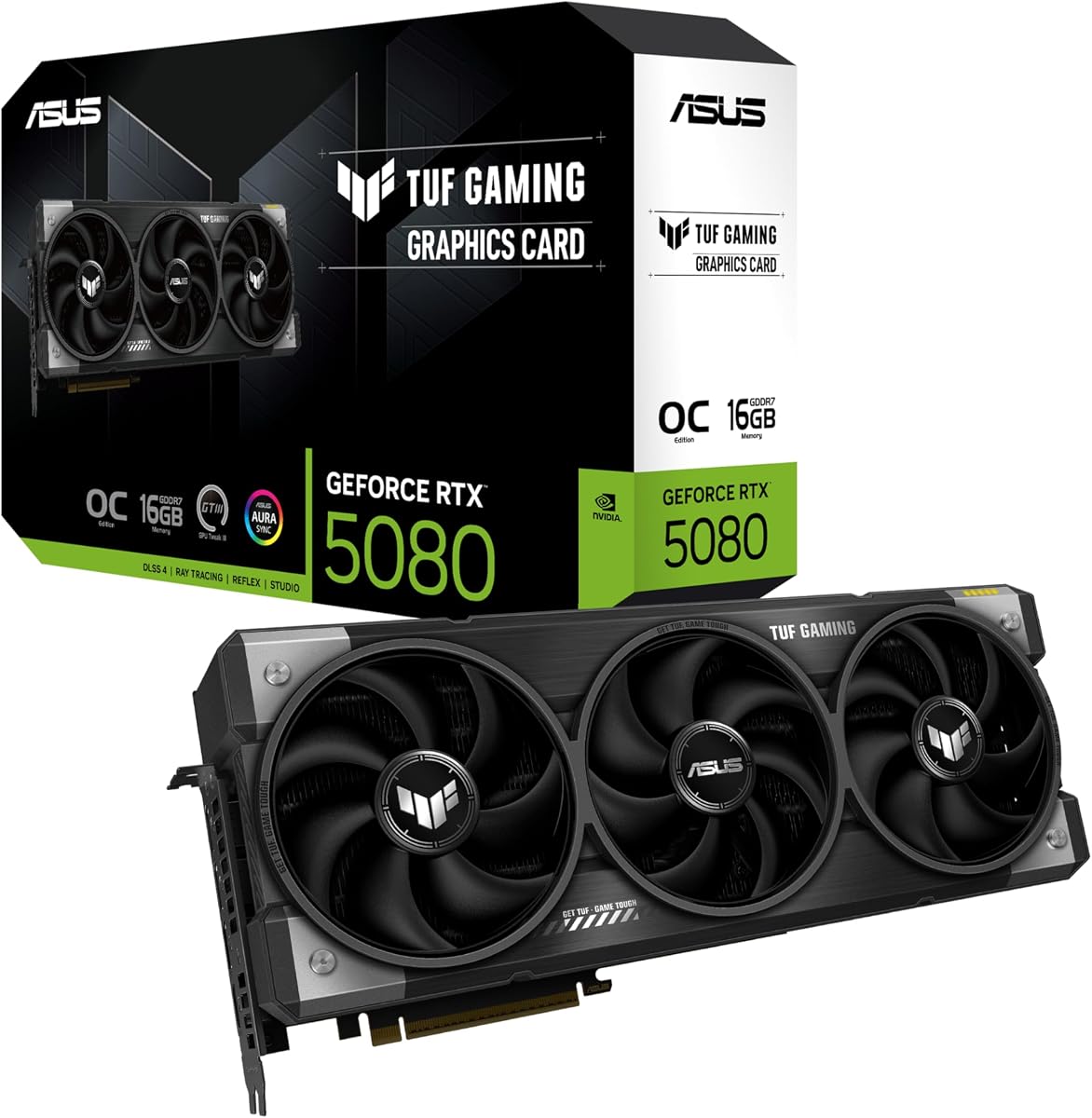
The ASUS TUF Gaming GeForce RTX 5080 16GB combines high performance with robust build quality. It is designed to withstand heavy loads and maintain performance over long periods.
We may earn a commission when you buy through this link, at no additional cost to you.
Military grade components ensure that the card lasts longer than standard consumer models. The phase change thermal pads help maintain optimal temperatures under sustained workloads.
This card is well suited for professionals who need reliability alongside speed. The cooling design ensures that performance does not throttle during long renders or exports.
Choose this card if you want a durable option for daily use. It provides the power needed for modern editing tasks while offering peace of mind for reliability.
These components ensure long term reliability and resistance to environmental stress.
Phase change pads ensure efficient heat transfer for better thermal performance.
We may earn a commission when you buy through this link, at no additional cost to you.
The ASRock Intel Arc Pro B60 Creator 24GB offers an interesting alternative with strong memory. It features dedicated media engines that can accelerate specific video tasks effectively.
We may earn a commission when you buy through this link, at no additional cost to you.
With 24GB of memory and twin media transcoders it handles export tasks well. The support for up to four displays makes it suitable for multi screen editing setups.
While performance has improved it still faces challenges with broad software support. However for specific workflows and budget friendly workstation builds it presents a viable option.
Consider this card if you want a professional profile at a lower price. It is best suited for users who value memory capacity and multi display support.
Dedicated engines support AV1 and HEVC for efficient video exports.
Four DisplayPort outputs allow for expansive multi monitor workflows.
We may earn a commission when you buy through this link, at no additional cost to you.
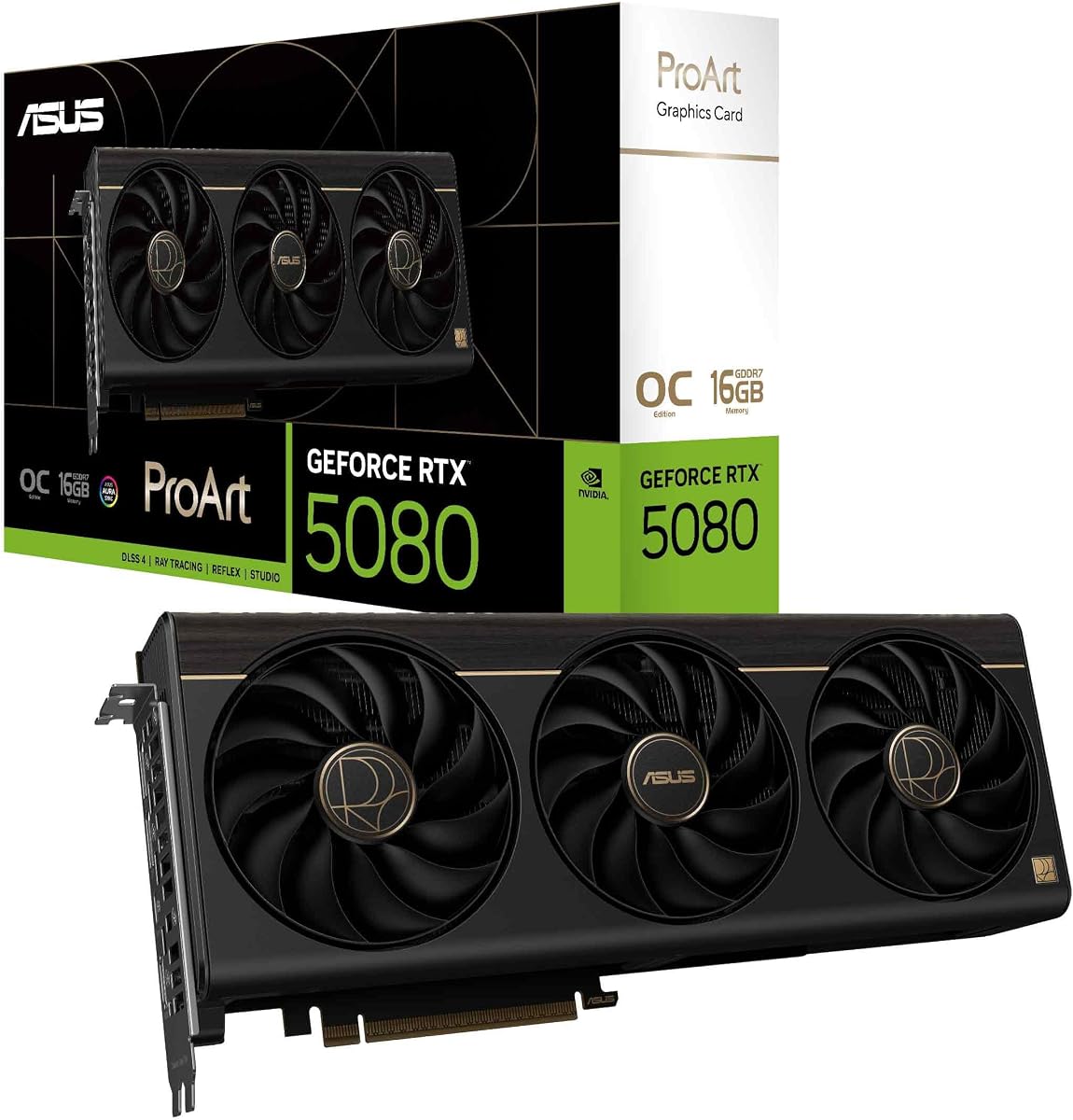
The ASUS ProArt GeForce RTX 5080 16GB is built specifically for creative professionals. It focuses on accuracy and reliability to meet the demands of colorists and editors.
We may earn a commission when you buy through this link, at no additional cost to you.
With a USB Type-C port it enhances connectivity for workflows that need direct device access. The MaxContact heatsink ensures that temperatures remain low during intensive grading tasks.
This card is ideal for users who prioritize color accuracy and build quality. It handles high resolution timelines smoothly and supports professional workflows with stability.
Choose this card if you work in color grading or high end production. It provides the performance and features needed to deliver professional results consistently.
Designed specifically for professional creators to ensure stable performance.
Integrated USB Type-C adds versatility for various content creation devices.
We may earn a commission when you buy through this link, at no additional cost to you.
The ASUS Dual GeForce RTX 5060 Ti 16GB offers a balance of affordability and capability. It brings modern architecture to a lower price point which helps many entry level editors.
We may earn a commission when you buy through this link, at no additional cost to you.
With 16GB of memory and 0dB technology it handles 4K projects quietly. The dual BIOS allows you to switch between performance and quiet modes based on your needs.
While it may not handle 8K editing as well as higher tier cards it is sufficient for most workflows. It is a great choice for those building a new workstation on a budget.
This GPU is perfect for students and indie editors starting out. It provides a solid foundation for learning and creating without breaking the bank.
0dB technology allows silent fan operation at low loads for better focus.
Switch between performance and quiet modes depending on your specific tasks.
We may earn a commission when you buy through this link, at no additional cost to you.
Selecting the right graphics card involves balancing performance needs with budget constraints and software compatibility.
VRAM is critical for high resolution editing and complex timelines. Aim for at least 16GB for 4K work to ensure smooth playback without crashes.
More memory allows you to load larger assets and effects without bottlenecks.
NVIDIA GPUs generally offer better support for Davinci Resolve due to CUDA and AI features. Look for the latest architecture to ensure future compatibility.
Newer cards include improved ray tracing and AI tools that speed up editing workflows.
High performance GPUs require substantial power supplies and cooling. Check your PSU wattage and case airflow before purchasing.
Ensure your system can handle the thermal and electrical demands of the card.
Some cards are optimized for professional workflows while others focus on gaming. Verify driver support for the specific version of Davinci Resolve you use.
Professional cards often offer certified drivers for stability in production environments.
Look for modern output standards like DisplayPort 2.1 if you use high resolution monitors. USB Type-C ports can also enhance workflow versatility.
Ensure the card has enough outputs for your multi monitor setup needs.
Efficient cooling prevents throttling during long render sessions. Blower designs suit multi GPU setups while standard fans suit single GPU systems.
Choose a cooling solution that fits your case and workload requirements.
Invest in a card that supports upcoming software features and formats. PCIe 5.0 support ensures compatibility with next generation motherboards.
Consider how long you plan to use the card before upgrading again.
Balance performance with cost to find the best value. Entry level cards work for basic edits while high end models suit professional facilities.
Determine your priority features to avoid overspending on unnecessary capabilities.
Install drivers from the manufacturer website to ensure compatibility with your software. Restart your system after installation to apply updates correctly.
Monitor GPU temperatures using built in tools to prevent overheating. Keep your workstation clean and dust free for optimal airflow.
Update software regularly to maintain stability and performance. Back up your projects to external storage for safe long term access.
Yes VRAM is essential for handling high resolution footage and complex effects. Low VRAM can lead to playback stutter and render failures.
NVIDIA is generally preferred due to strong CUDA and AI support. AMD and Intel are improving but may have limited features.
Aim for at least 16GB of VRAM for smooth 4K playback. More memory helps when using advanced color grading tools.
Not always consumer cards can handle most editing tasks well. Professional cards offer better stability for enterprise environments.
Newer architecture provides better efficiency and AI capabilities. It ensures compatibility with the latest software features and updates.
Check the number and type of display outputs available. Ensure your card supports the resolution and refresh rates of all monitors.
The GIGABYTE GeForce RTX 5080 leads the pack with balanced performance and features. Budget options like the ASUS Dual RTX 5060 Ti offer solid value.
Prioritize memory capacity and architecture to ensure your system meets current and future needs. Always check compatibility before purchasing to avoid issues.
Prices and availability change so verify details before buying your new graphics card.